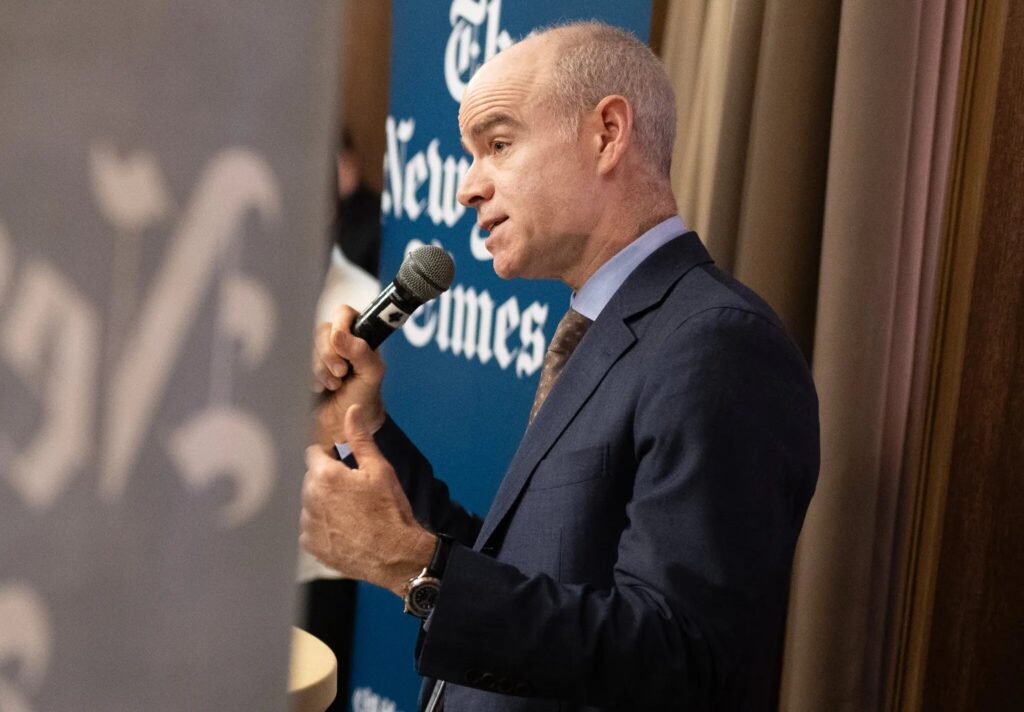

Joe Kahn, the executive editor of the New York Times, says the hardest part of his job these days is resisting the pressure from readers. But he seriously misunderstands what those readers want.
He thinks Times readers want the news organization to turn into the Fox News of the left. “The most challenging part of the job is producing an independent news report, when some readers really want a more partisan one,” he said in a recent Q&A.
“Our readers of course have their own beliefs and loyalties, and some want to see more coverage that aligns with their views,” he said.
“Readers already have access to a vast amount of opinion and commentary on the internet that can validate their worldviews. That’s not our role.”
He’s been making this same argument ever since he took over from Dean Baquet in 2022. In an interview in May 2024, for instance, Kahn cast critics as wanting the Times to give up its core values: “To say that the threats of democracy are so great that the media is going to abandon its central role as a source of impartial information to help people vote — that’s essentially saying that the news media should become a propaganda arm for a single candidate, because we prefer that candidate’s agenda.”
But readers are not asking the Times to print propaganda or stump for Democrats. In my view, they simply want the Times to be more clear-eyed and honest about the depth of the crisis this country currently faces.
What readers want is for the Times to fully and consistently acknowledge incontrovertible aspects of the Trump era that are essential to understanding what is driving the news. They feel that ignoring the bigger picture in incremental stories is tantamount to spreading misinformation.
What are those seminal truths that supply essential context to the daily news report? Here’s my list:
- That the United States has become an authoritarian state, with armed soldiers on city streets; immigrant neighbors abducted and disappeared by masked agents; the state seizing stakes of companies; political opponents targeted with criminal probes; educational institutions extorted into obedience; media organizations paying tribute to the ruler. This is reality.
- That Trump is personally deranged and debilitated. That he operates almost entirely in a bubble world of lies and fantasies. That he makes things up, is misled by his staff, and often doesn’t know what they are doing.
- That white Christian nationalism and virulent racism are primary drivers in this administration.
- That misinformation and lies are not coincidental to the Trump agenda, they are essential to it.
- That Trump is engaged in a massively corrupt scheme to enrich himself, his family, and his oligarch friends.
- That Trump is leading what is effectively a criminal enterprise – openly violating the law at almost every turn.
- That the Trump administration is systemically diminishing hard-fought civil and human rights for women, for immigrants, for brown people, and for trans people.
- That the Republican Party of the past no longer exists. It is no longer serious or credible.
- That the nation’s historic checks and balances, through the separation of powers, have collapsed.
- That the federal government – especially the Department of Justice and the Department of Homeland Security – has been so weaponized against Trump’s political opponents that nothing it says can be trusted without evidence.
- That Trump’s cruelty and racism have been fully embraced by the MAGA movement and by federal agents terrorizing and abducting immigrants.
These are not things to hint at or to allude to in the occasional news analysis. These are the central realities of almost everything that is happening in our political sphere. It is crucial to openly acknowledge them – repeatedly — to accurately describe what is going on.
Eliding them in a news report – just reporting what happened, without this crucial context – normalizes the abnormal. It makes the inarguable arguable. It eases the path to greater authoritarianism.
What the Times Does Wrong
I’ve written extensively over the years about how the Times’s political reporting has lost its bearings. I blamed the Times for Trump’s victory. I’ve described the joy the Times takes in taking cheap shots at the left. I’ve written about Times publisher A.G. Sulzberger, from whom Kahn takes his cues. I’ve proposed additions to its style guide.
The Times’s faults have been consistent over time. And they continue to this day.
For instance, the Times treats alarm about Trump’s authoritarianism as partisan. See, for instance, this article from October:
Democrats have watched with increasing alarm as the administration has ignored congressional spending directives, dispatched the military to American cities, ordered government retribution against Mr. Trump’s perceived adversaries and mounted an aggressive immigration roundup that has prompted fierce fights in the courts.
(It’s not just Democrats.)
Articles like this one from last week use attributions like “critics say” or “Democrats say” to distance the Times from conclusions that are obvious to anyone with half a brain:
But critics say the sweeping nature of his actions, including the deportation of a college freshman who had lived in the United States for 12 years, calls into question the claim that Mr. Trump’s deportation campaign is meant to target the “worst of the worst.”
The Times prints the administration’s lies in headlines, like this one: “What Are National Guard Troops Doing in Washington? The troops are deployed in the capital as part of the president’s crackdown on crime” (there is no crackdown on crime); and U.S. Strikes 2nd Boat in Pacific as Antidrug Operation Expands (it isn’t about drugs.)
The Times uses week euphemisms to describe Trump’s conduct, like in this article, which describes Trump’s blatantly illegal diversion of congressionally-mandated funds during the shutdown as “novel,” “unusual”, and “unorthodox”.
And in this article, Times reporter Peter Baker managed to simultaneously downplay and both-sides Trump’s campaign of political retribution – by suggesting that it will only be a sign of authoritarianism once Democrats, inevitably, do it too:
If the precedent set by Mr. Trump takes hold, America may be entering a period when each new administration takes aim at the last one in a cycle of retaliation, a what-goes-around-comes-around pattern more familiar in authoritarian countries than in developed Western democracies. Even presidents more restrained than Mr. Trump may succumb to the temptation to follow at least some of his example.
Baby Steps?
All that said, the Times is doing better than it used to. (I wrote a whole column about that in September.) Sometimes it actually gets close to calling out Trumpism for what it is.
But even then it still holds back – in fact, it stops maddeningly short of declaring the truth in its own voice.
Here’s an article from November sparked by a clear example of Trumpian hypocrisy: “In Announcing Pardon of Drug Trafficker While Threatening Venezuela, Trump Displays Contradictions.”
“Contradictions”? Really?
In his own words, author Tyler Page only goes so far as to call it “remarkable dissonance.” He leaves it to a Democrat to state the obvious conclusion:
Senator Tim Kaine, Democrat of Virginia, called the pardon “unconscionable” and said that Mr. Trump’s actions were more evidence of a “bogus narrative” around his strategy to counter illicit drugs.
“It completely undercuts the administration’s claim that they really care about narco-trafficking, and that raises the question of what is really going on with the Venezuela operation,” he said.
There was some surprisingly bold truth-telling in this article by Zolan Kanno-Youngs and Shawn McCreesh about Trump’s racist screed about Somalia last week:
President Trump unleashed a xenophobic tirade against Somali immigrants on Tuesday, calling them “garbage” he does not want in the United States in an outburst that captured the raw nativism that has animated his approach to immigration.
Even for Mr. Trump — who has a long history of insulting Black people, particularly those from African countries — his outburst was shocking in its unapologetic bigotry. And it comes as he started a new ICE operation targeting Somalis in the Minneapolis-St. Paul region.
It included this important context:
Mr. Trump has seized on immigration as a potent political weapon, demonizing immigrants and equating them with crime and disease. He often returns most furiously to the topic when he is on the defensive, as he is now, over issues like the economy and the Epstein files.
But the Times quickly went back to ignoring Trump’s racism. Four days after the Somalia piece, an article about how the U.S. is abruptly canceling long-sought citizenship oath ceremonies for people from targeted countries left out any mention of the blatant racial animus underlying the choice of those countries. (The article’s headline – “One Step From Citizenship, Some Find It Eludes Their Grasp” – was a passive and deceptive horror.)
In another sign of boldness – but boldness that only extends so far – the Times’s coverage of the deadly boat strikes off the South American coast has evolved considerably since the first, utterly credulous headlines.
The Times is in fact getting closer and closer to calling them murder. Note the absence of hemming and hawing and “critics say” bullshit in these paragraphs from a December 4 article by Charlie Savage and Julian E. Barnes:
As a matter of plain reality, an unarmed speedboat, even if it is carrying cocaine, is not a warship. And none of the 11 people aboard — not merely the two initial survivors, but also the nine people the U.S. military killed in its first strike — were fighting anyone.
And
The United States has long handled the problem of maritime drug smuggling by using the Coast Guard to intercept boats and to arrest people. That echoes how it works on land: Police officers who believe people are dealing drugs arrest them, and if they are convicted, they serve time in prison. They are not executed.
It would be a crime if officers instead simply gunned down suspected drug dealers in the street. Similarly, a military force is not allowed to target civilians, and being a suspected criminal does not make someone lose civilian status. In peacetime, targeting a civilian is murder. In an armed conflict, targeting a civilian is a war crime.
Nevertheless, the headline and the overall framing of the story was that the illegality of the strikes is an open question, rather than one that has already been overwhelmingly answered in the affirmative by everyone but the administration and its defenders.
There is, possibly, some hope for greater improvement — but it will come in spite of Kahn, not because of him.
The Kahn Factor
New York Times reporters are not stupid, nor are they blind. I believe that most Times reporters covering the Trump administration recognize the truths I listed above.
So why does their coverage not reflect that?
Because Joe Kahn confuses truth-telling with partisanship. In a country where the divide is not just about politics but about truth, he still believes there is a center, and that the Times should inhabit it.
And the Times’s reporters – and, perhaps more importantly, the mid-level editors who edit their copy and write their headlines – fear his wrath.
I’m particularly frustrated that Kahn – just like his predecessor and just like his boss – refuses to engage with good-faithed criticism. Instead of talking directly with his critics, he agrees to interviews with sycophants who set him up with softballs and don’t dispute his straw man arguments.
If he did listen, Kahn would hear a clear and simple message: The unique dangers that Trump poses to our nation demand a more assertive journalism. The Times needs to start connecting the dots. It needs to declare a state of emergency. And it needs to help us figure out how to survive it.