
Why does someone who overstayed their visa need to be held in shackles? Why does someone who isn’t a flight risk need to be indefinitely confined in a filthy overcrowded cell? Does any child belong in a prison camp? Does anybody at all deserve to be forced to sleep on a concrete floor, or underfed, or brutalized, or denied medical care?
Why is this being allowed to continue?
These are some of the questions journalists should be raising as they step up their coverage of the inhumane treatment of potentially tens of thousands of people who have been caught up in Donald Trump’s brutal immigrant dragnet.
The terrorizing of American cities by masked federal agents was, by comparison, an easy story to tell, due to all the people shooting videos and posting them on social media. Even then, it took months — and the murder of two white people — for the news media to fully recognize what was going on.
The detention story will be much tougher, because it’s all happening behind locked doors. But it is essential that the news media not effectively sanction this kind of inhumanity by turning a blind eye to it.
There has been some isolated and excellent reporting on conditions in these facilities – I link to some examples below. But that’s not enough. We need a drumbeat of stories that continues as long as the inhumane conduct continues. We need our best investigative reporters and feature writers on the case. We need to be relentless.
Civil, Not Criminal, Violations
First off, the coverage should stress that 75 percent of the detainees have no criminal convictions, and many of those convicted committed only minor offenses, including traffic violations. They shouldn’t be treated like criminals at all.
A federal judge in West Virginia made that point eloquently last week while ordering the release of Mexican couple who were detained after a traffic stop. Judge Joseph R. Goodwin wrote:
The husband and wife before this court are charged with civil violations of our country’s immigration laws. Civil. Not criminal. That distinction is not a technicality or a formality. It is the line the law draws between regulation and punishment. Yet these two working parents appear in unmistakable prison garb. They wear orange jumpsuits, are shackled, and are restrained in heavy chains. They have been kept away from their children, forced to languish in detention hundreds of miles away from where they live and work. They have been confined for days alongside persons accused of or convicted of crimes. They are held without any custody determination or bond hearing. This is not what civil enforcement looks like in a humane system of government under law.
Start With El Paso
Nearly 70,000 people are currently in immigration detention, according to the research group TRAC Immigration.
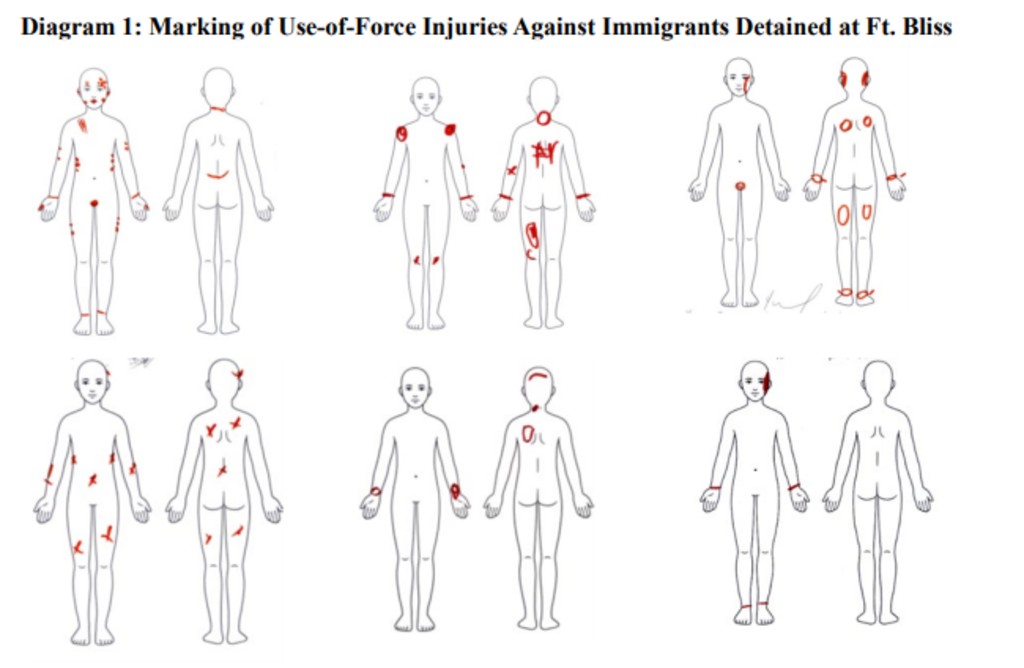
Camp East Montana, located at Fort Bliss in El Paso, Texas, averages about 3,000 detainees per day, making it the largest single facility. That’s a good place to start reporting on inhumane conditions.
The American Civil Liberties Union has documented dozens of accounts of physical and sexual abuse, medical neglect, and intimidation at East Montana.
“Detained immigrants are held for weeks at a time with no access to the outdoors in cramped, squalid soft-sided tents with 72 people per unit, where toilets and showers flood eating areas with raw sewage,” the group wrote in a December letter to Trump administration officials.
“These accounts reveal an unfolding humanitarian crisis,” the group concluded.
Three detainees died there in a recent 44 day period, El Pais reported. That includes one death that was ruled a homicide.
Three dozen Texas state legislators have requested an investigation into the camp’s conditions. “We have received numerous credible reports of torture, killing, and inhumane treatment of detained individuals at the Camp East Montana migrant detention facility,” State Rep. Ana-María Rodríguez Ramos said on social media.
The Washington Post reported on an inspection report that found that “migrants were subjected to conditions that violated at least 60 federal standards for immigrant detention.”
And two cases of tuberculosis were detected there recently.
That’s just one facility. The next-largest ones are in Natchez, Mississippi; Lumpkin, Georgia; Adelanto, California; and Pearsall, Texas.
Here’s a list of all of them. Find one near you.
Encourage Members of Congress to Inspect Facilities
Trump’s Justice Department has fought hard to deny members of Congress the right to make unannounced inspections of immigration facilities. I wonder why. That right, however, was reaffirmed last week by a federal judge.
News organizations should encourage members of Congress to inspect local facilities and provide detailed reports to the public.
Rep. Jamie Raskin, the ranking Democrat on the House Judiciary Committee, visited a Baltimore ICE field facility last week. He announced on Facebook:
I just exercised my right as a Member of Congress to conduct an unannounced oversight visit of the ICE field facility in Baltimore. The staff I met with respected my right to visit, but what I saw was disgraceful. Kristi Noem has a budget of $75 billion she could use to ensure humane conditions, but we saw 60 men packed into a room shoulder-to-shoulder, 24-hours-a-day, with a single toilet in the room and no shower facilities. They sleep like sardines with aluminum foil blankets. Whether it’s for three days or seven days, nobody would want a member of their family warehoused there. The room set aside for dangerous criminals and violent offenders was empty. We’re demanding immediate answers and action.
Interview Current and Former Detainees
Some of the most vivid accounts of what detention is like have come from the people inside, by phone or Zoom.
Seamus Culleton spoke to the Irish Times about his experiences. Originally from Ireland, Culleton is married to a US citizen, owns a plastering business, and has no criminal record.
In a phone interview from the El Paso facility, he said conditions there are “like a concentration camp, absolute hell”. The Times reported:
He said he has been locked in the same large, cold and damp room for 4½ months with more than 70 men. He said detainees are constantly hungry because meals served at tables in the centre of the room offer only child-sized portions. Fights often break out over food, “even over those little child-sized juice containers”. Toilet areas are “filthy”.
NBC News spoke by Zoom with a Russian couple who, along with their two children, have been held in the immigrant detention center in Dilley, Texas, for four months now. NBC reported:
Worms in their food. Guards shouting orders and snatching toys from small hands. Restless nights under fluorescent lights that never fully go dark. Hours in line for a single pill.
“We left one tyranny and came to another kind of tyranny,” Nikita said in Russian. “Even in Russia, they don’t treat children like this.”
Talk to Other Witnesses
Journalists should also seek out attorneys who are allowed access to detention facilities, as well as current and former employees.
Attorneys for the Minneapolis nonprofit Advocates for Human Rights, for instance, visited the Whipple federal building on Monday, where thousands of people from the Twin Cities have been detained.
In a declaration in the group’s lawsuit – which is over the lack of access to legal counsel, and which they won — Hanne Sandison, one of the attorneys, wrote:
All detainees I observed were shackled at the ankles, even while sleeping and in the holding cells. From my observations of several holding cells, I did not see any detainee who had a blanket, pillow, sleeping pad, or cot. I saw men sleeping on the floor with no bedding.
Eric Lee, a Michigan-based immigration lawyer who has visited clients in the Dilley facility in Texas, where families with children are held, told MPR News:
The conditions in this facility are absolutely abysmal. They mix baby formula with water that is putrid. The food has bugs in it. The guards are often verbally abusive. One of my clients had appendicitis, collapsed in the hallway, was vomiting from pain, and the officials told him, take a Tylenol and come back in three days.
And a former employee at the Baltimore ICE detention facility told WUSA9 that he saw abuse as soon as he started working there. “I saw people laying in feces. People throwing up, people laying in urine,” he said. “People slept on the floor. We have bugs in there and they slept on the floor. The cold floor,” the man said, comparing the scenes to “pictures that I saw in elementary school of how they brought the slaves from Africa.”
Focus on the Kids
The stories about children being seized and held in detention have a particular resonance.
The outcry over a viral photo of a five-year-old boy with a bunny hat and Spider-Man backpack being abducted by ICE agents led to his release from the Dilley facility after a week.

But many other children are still there. ProPublica reporter Mica Rosenberg got inside the facility, talked to children and their families, and got the children to write her letters. She reported:
Among them was a letter from a 9-year-old Venezuelan girl, named Susej Fernández, who had been living in Houston when she and her mother were detained. “I have been 50 days in Dilley Immigration Processing Center,” she wrote. “Seen how people like me, immigrants are been treated changes my perspective about the U.S. My mom and I came to The U.S looking for a good and safe place to live.”
Aerial photos taken by the Associated Press in late January showed dozens of children and parents protesting behind Dilley’s fences, some of them holding signs that said “Libertad para los niños,” or “Liberty for the kids.”
“The message we want to send is for them to treat us with dignity and according to the law. We’re immigrants, with children, not criminals,” Maria Alejandra Montoya Sanchez, 31, told the AP in a phone interview from the facility after the demonstration.
Just last week, two Dilley detainees tested positive for measles, leading Rep. Joaquin Castro, the Texas Democrat, to call for Dilley to be shut down immediately. “Because of the close-quarter conditions at Dilley, lack of prompt medical response and capacity, and lack of expertise with diseases such as measles, Dilley is not equipped to combat any spread,” Castro wrote on social media.
Keep Following These Court Cases
For the past six months, in what it calls its “mandatory detention” policy, the Trump administration has insisted on detaining the immigrants it captures without due process – when historically they have been able to be released on bond pending a court ruling.
Politico’s Kyle Cheney reported in January that more than 300 federal judges, “including appointees of every president since Ronald Reagan” had ruled against the new policy. It’s 373 at Cheney’s last count.
Reuters is now out with its own analysis, reporting that more than 400 federal judges — in 4,421 separate cases — have ruled since the beginning of October that ICE is holding people illegally. Most of those rulings center on the “mandatory detention” policy.
The policy remains in effect, however, especially after the administration received a green light last week from two far-right judges on a three-judge panel of the Fifth Circuit.
But other appeals courts are likely to address the issue in the coming weeks. There might be an en banc hearing in the Fifth Circuit. And Cheney reported last week that even in that circuit some district judges have found a workaround.
Write Expansively About ICE’s Warehouse Spree
One element of the immigration story that’s getting a lot of play is ICE’s ongoing attempt to buy massive warehouses all over the country to turn into detention centers.
Local residents and officials don’t want them, and the fight has turned into another major front in the resistance, as I wrote earlier this month in my other newsletter, Heads Up News.
The Washington Post broke the news in December about ICE’s plan to buy warehouses to hold another 80,000 detainees at a time. And last week, the Post reported on the plan’s whopping $38.3 billion pricetag – “more than the total annual spending for 22 states.”
But given the inhumane conditions in existing facilities, reporters should be asking probing questions about the entire initiative, not just the new buildings. What are they doing here?
Furthermore, do the new plans mean that ICE intends to be holding 150,000 people at a time in detention for years to come? Why? Will detainees stay there indefinitely? Who will run the camps? Who will hold them accountable for their conduct?
Cover the Protests Outside ICE Facilities
Another way into this story is to cover the people protesting outside the existing ICE facilities.
WHEC TV in Rochester, New York, reported on a protest Sunday during which around 100 people gathered for a demonstration outside the detention facility in Batavia, participating in a 39-minute moment of silence. Why 39 minutes? Dr. Leah Ntuala, a Seneca Falls reverend who organized the protest, told the station that each minute of silence represented someone killed in ICE custody or at a protest.
According to the news site L.A. Taco, hundreds of San Diegans have been gathering every Sunday since early November outside their city’s Otay Mesa detention facility.
Some detainees have started sending them handwritten notes wrapped around lotion bottles that they throw over the facility’s walls and fences, L.A. Taco reported.
“Good afternoon. My name is [redacted] and my wife and I have been at OMDC since April 15 2025,” reads one note. “For 280 days we haven’t eaten a single piece of fruit, banana, apple, orange, or anything fresh. We are all in one big room with no doors or windows. We can’t see any grass or trees. We are all constantly sick.”
Some Opinion Writers Get It
Two New York Times opinion writers have been trying to get folks to focus on these problems. Jamelle Bouie wrote in January:
The public face of Immigration and Customs Enforcement is a brutal, paramilitary force of masked men who hunt immigrants and terrorize American cities on behalf of the president of the United States.
The not-so-public face is somehow even worse.
He expanded on that last week:
Immigration detention is not a criminal procedure. And yet the Trump administration is treating it as a criminal punishment. It is using detention to inflict pain on anyone — immigrant or citizen — caught in its grasp. It is subjecting detainees to horrific conditions of deprivation and abuse, meant to pressure people into leaving the country, even if they have valid asylum claims or even legal status.
And fellow Times columnist David French wrote:
It’s as if we’re throwing people into overcrowded jails for the legal equivalent of failing to pay a credit-card bill or losing a lawsuit — immigration detention as the new debtors’ prison.
Even worse still, we are subjecting human beings to extended confinement in detention facilities that — if human rights groups, detainees and whistle-blowers are to be believed — are often not up to the standards of America’s prisons or jails. They aren’t even up to the standards we set in my regiment for detaining suspected insurgents in Iraq.
This One Matters
The news media has become inured to so many previously unthinkable things that are happening under Trump, many of them in flat violation of the Constitution.
But the inhumane treatment of tens of thousands of people by the US government should still shock the conscience. It is an urgent and terrible problem.
History will look back in horror at the people who engineered it – and the people who enabled it. It will look back kindly on those who exposed it and fought it.