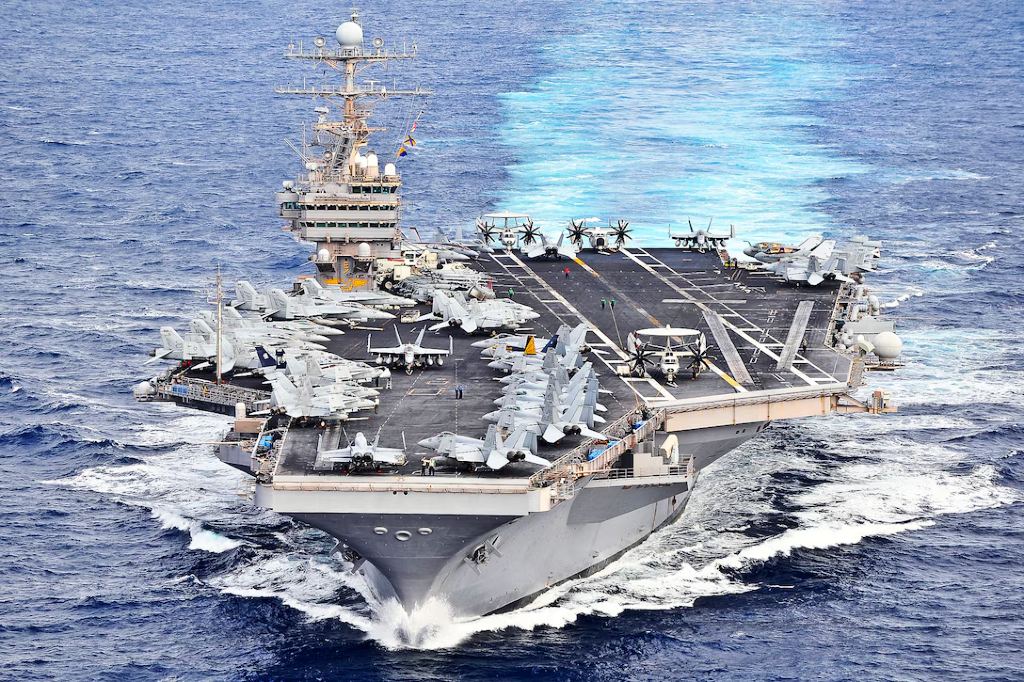

Donald Trump may well be careening into a major war, and the American corporate media coverage is credulous, stenographic, and feeble when it should be vigorously alerting the American people to how dangerous and counterproductive the war could be, to the lack of any reasoned argument in its favor, to how it would violate one of Trump’s key campaign promises, and to the fact that Trump has not received authorization from Congress as required by the Constitution.
American journalists are busy speculating on will-he-or-won’t he and dutifully noting the position of military assets. What they should be doing is asking Trump officials some essential questions on behalf of the public — and calling attention to the lack of answers.
Some of those essential questions:
- Why would you go to war?
- What legal justification do you have to go to war?
- How can you justify going to war without getting Congressional authorization?
- How can you justify going to war when the public is resoundingly against it?
- What do you expect to get out of going to war?
- How will this make things better rather than worse?
- How long will the war last?
- How does the war end?
- How much will it cost, and how will you pay for it?
And for all of these, a follow-up question: Show us your supporting evidence.
The fact is that there is almost no more important job for the news media than to demand answers to these sorts of questions before a president takes the country to war.
There is also some context specific to Trump: He’s erratic, deranged, and impulsive. There can be no assumption that this is a reasoned decision. Journalists should make that clear as well.
And did no one learn the lessons from the cowardly, cheerleading mainstream-media coverage of the run-up to the Iraq War? I’m really agog at how understated the coverage is.
As I wrote last June, I believe journalists have a particular obligation to inform the public about the dangers and horrors of war. They are a repository of certain truths about war: That it is horrible; that it is easier to get into a war than get out of it; that war is often entered into under false pretenses; that when it comes to war, governments lie.
And journalists can uniquely remind their audiences of the humanity of the “other” – in this case, of the Iranian people who would be killed, injured and displaced by American intervention.
If nothing else, journalists should make it clear that the public does not support going to war, by at 49 to 21 margin in one poll, and a 48 to 28 margin in another.
So far, pretty much the only corporate-media pushback I’ve heard of is coming from MS NOW. I didn’t see it myself, but CNN’s Brian Stelter reported in his newsletter this morning that MS NOW contributor Philip Bump noted last night that “no one is paying attention to this, and that’s the staggering thing.”
And also on MS NOW, New York Times opinion columnist Michelle Goldberg pointed out that the Trump administration hasn’t “articulated what this potential war is supposed to accomplish, what its ends would be, what success would mean, whether they intend it to be regime change.” She continued: “I never in my life thought that I would feel nostalgic for being lied to by George W. Bush in the run-up to the Iraq war, but this is an administration that doesn’t even feel the need to propagandize the population, because it doesn’t feel like it needs the consent of the governed at all.”
Let me point you to some valuable journalism about how big a mistake the war could be. Surprise – it’s not from this country.
Bamo Nouri, a scholar at the University of London, recently wrote an essay for The Conversation headlined “Why it would be a big mistake for the US to go to war with Iran”. Among his salient points:
- Trump promised to end costly overseas interventions. But Iran represents the very definition of a forever war.
- Because of Iran’s asymmetric capabilities, an attack would lead to prolonged and escalating costs.
- Tehran could disrupt shipping through the Strait of Hormuz, driving up oil prices and inflation.
- Military pressure could backfire politically, strengthen internal cohesion, and further marginalize opposition movements.
Dan Sabbagh, the defense and security editor for the Guardian, asked what an attack would achieve. Capturing Iran’s supreme leader, Ayatollah Ali Khamenei, would be much more difficult than capturing Venezuela’s leader was, he noted. An assassination, by contrast, would “represent an extraordinary escalation: an attempt by the US to kill the leader of another country with which it is not at war, and from which it faces no immediate threat.”
And the BBC has published a very useful article headlined “What could happen if the US strikes Iran? Here are seven scenarios.” I’ll summarize:
- Targeted, surgical strikes, minimal civilian casualties, a transition to democracy. This is a highly optimistic scenario. Western military intervention in both Iraq and Libya did not bring a smooth transition to democracy. Although it ended brutal dictatorships in both cases, it ushered in years of chaos and bloodshed.
- Regime survives but moderates its policies. This is at the more unlikely end of the scale. The Islamic Republic leadership has remained defiant and resistant to change for 47 years. It appears incapable of changing course now.
- Regime collapses, replaced by military rule. Many think this is the most likely possible outcome. In the confusion of the aftermath of any US strikes it is conceivable that Iran ends up being ruled by a strong, military government composed largely of Islamic Revolutionary Guards Corps figures.
- Iran retaliates by attacking US forces and neighbors. It is clearly no match for the might of the US Navy and Air Force but it could still lash out with its arsenal of ballistic missiles and drones, many concealed in caves, underground or in remote mountainsides.
- Iran retaliates by laying mines in the Gulf. Iran has conducted exercises in rapidly deploying sea mines. If it did so then it would inevitably impact world trade and oil prices.
- Iran retaliates, sinking a US warship. The sinking of a US warship, accompanied by the possible capture of survivors among its crew, would be a massive humiliation for the US.
- Regime collapses, replaced by chaos. This is a very real danger and is one of the major concerns of neighbors like Qatar and Saudi Arabia.
The best-case scenario is that this is just another example of Trump being intentionally erratic, to keep the other side off balance during a negotiation.
Patrick Wintour, the diplomatic editor of the Guardian, noted that the first report that a full-scale attack might be imminent came from Axios. Axios is known for floating trial balloons for the administration.
Wintour wrote: “Inevitably the story, along with the armada, could be seen as another part of coercive diplomacy. The Trump team’s modus operandi often seems to be to ‘speak softly [to Axios] and carry a big stick’”.
Mr. Froomkin. While I applaud your efforts to goad journalists into action to better inform the public, I sometimes wonder if you are not just barking at the moon. I am a former journalist and from my experience I believe journalists are not the brightest bulbs in the chandelier and they are lazy. The White House press corps epitomizes journalists who lack critical thought and the courage to challenge Trump and his toadies. Their editors are content with softball questions to Trump and his evasive answers to a rare, insightful question. It’s really just a charade; a well-rehearsed game journalists and politicians play. White House reporters keep their cushy jobs with seeming access to politicians and politicians count on benign press coverage. In other words, everyone is acting in their own best interest. Very rarely does a journalist reject the status quo and demand more from politicians. There are thousands of people working as journalists, but very rarely do we see an Edward R. Morrow, a Cronkite, a Woodward, or Bernstein. Journalism is a profession for the dull and lazy. If you can continue to tolerate being journalism’s Don Quixote, I wish you well and certainly thank you for trying.
Thank you for that word salad! Some journalist!!