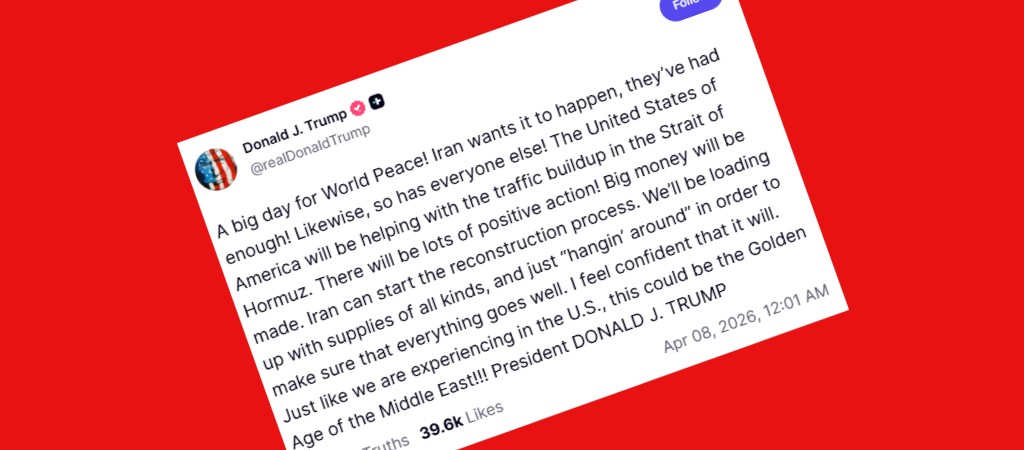

Donald Trump changed his mind about something monumental on Tuesday, and we don’t know why.
Despite all the vaunted access that journalists have to Trump and his aides, despite the endless social media posts, we can’t answer that crucial question.
And, as I will argue below, the biggest reason we don’t know why Trump did what he did is that Trump is mentally unbalanced. It could have been anything, really. But our top political journalists are too cowed to say so.
A Timeline
It certainly wasn’t what the White House is saying: That Iran caved because of Trump’s threats.
Consider the sequence of events:
As of 8:06 a.m. Tuesday, Trump was promising, in unspeakably evil terms, to turn Iran’s civilian infrastructure – and maybe more – to rubble.
He infamously posted on his social media platform that “A whole civilization will die tonight, never to be brought back again.” There was only one way out: if “something revolutionarily wonderful” happened before his 8 p.m. deadline.
For context, this came two days after his Easter Sunday post: “Open the Fuckin’ Strait, you crazy bastards, or you’ll be living in Hell – JUST WATCH! Praise be to Allah.”
In his April 1 address to the nation, he warned that “Over the next two to three weeks, we’re going to bring them back to the stone ages, where they belong.”
His March 6 vow that “There will be no deal with Iran except UNCONDITIONAL SURRENDER!” was still operative.
Indeed, at Monday morning’s Easter Egg Roll on the White House lawn, in comments to reporters that I don’t think have gotten enough attention, Trump made it clear what he still felt Iran needed to do:
I hate to do it, but we’re obliterating and they just don’t want to say uncle. They don’t want to cry, as the expression goes, uncle, but they will. And if they don’t, they’ll have no bridges, they’ll have no power plants, they’ll have no anything. I won’t — I won’t go further, because there are other things that are worse than those two, and we might have — well, the thing — if I had my choice, what would I like to do, take the oil.
He acknowledged that the Iranians had made a move
They’ve made a proposal, and it’s a significant proposal. It’s a significant step. It’s not good enough, but it’s a very significant step. They have made — they’re negotiating now, and they’ve made a very significant step. We’ll see what happens.
So what was that Iranian proposal?
It was Iran’s 10-point plan! The exact same proposal that Trump the next night – Tuesday night — would call “a workable basis on which to negotiate.” The exact same proposal that he sounded ecstatic about when he posted: “This could be the Golden Age of the Middle East!!!”
As the New York Times reported on Monday:
Iran has conveyed to Pakistan its own proposal to end the war consisting of 10 points, according to Iranian state media. The state news agency IRNA indicated the proposal was made after “the developments over Saturday and Sunday in western and central Iran,” which it described as the “catastrophic failure” of a U.S. operation. An Air Force officer whose fighter jet had been shot down by Iran was rescued by U.S. Special Operations forces in a risky mission on Saturday.
Iranian state media has not detailed the entirety of the proposal, but it has noted some conditions or topics that were included. Among them, it said, was a protocol for safe passage through the Strait of Hormuz. It also outlined Iranian demands for lifting sanctions and for reconstruction.
So what happened during the day Tuesday that changed Trump’s mind? It wasn’t the receipt of the 10-point plan. That was on Monday. It wasn’t that Iran cried uncle.
We don’t know what it was.
The White House’s Lies
The sequence I just described clearly refutes the White House line — echoed by some credulous Washington journalists — that it was Trump’s apocalyptic threats that brought Iran to make a “workable” proposal, and that’s why he changed his mind.
White House press secretary Karoline Leavitt said it on Wednesday: “I think it was a very, very strong threat from the president of the United States that led the Iranian regime to cave to their knees and ask for a ceasefire and agree to reopening the Strait of Hormuz… It was a very strong threat that led to results, and as the Secretary of War stated at the Pentagon this morning, it was not an empty threat by any means.”
Influential reporters like David Sanger of the New York Times bought it: “Mr. Trump’s tactic of escalating his rhetoric to astronomical levels certainly helped him find an offramp he had been seeking for weeks,” Sanger wrote on Wednesday. “Without question, it was a down-to-the-wire tactical victory.”
Isaac Arnsdorf wrote for the Washington Post on Wednesday that “Tuesday’s ultimatum that ‘a whole civilization will die tonight,’ … yielded a two-week ceasefire in Iran and an assurance that the country’s leaders would let oil tankers through the Strait of Hormuz.”
An Associated Press article on Wednesday headlined “How Trump went from threatening Iran’s annihilation to agreeing to a 2-week ceasefire with Tehran“ failed to deliver as advertised, concluding weakly that “The dramatic shift in tenor came as intermediaries led by Pakistan worked feverishly to head off a further escalation.”
Even Al Jazeera, attempting to explain the U-turn it described as “‘Stone Age’ to ‘Golden Age’,” vaguely credited the reversal to “last‑minute diplomacy mediated by Pakistan” — the only evidence of which was a tweet from Shehbaz Sharif, the prime minister of Pakistan, begging Trump to extend his deadline for two weeks on account of unspecified “diplomatic efforts.”
And let’s be real: Iran doesn’t appear to have made any concessions at all since Trump impulsively started the war on Feb. 28.
Iran’s 10-point plan – that, again, Iran put forth on Monday, not Tuesday –actually seems if anything broader and more demanding than the 5-point plan Iran advanced earlier in the war.
It specifies, for instance, that the U.S. will accept an Iranian right to enrich uranium, and that Iran will continue to control the Strait of Hormuz.
It could barely be more diametrically opposite to the 15-point plan the Trump administration put together in late March, which included a ban on enrichment and a free and open Strait of Hormuz.
And, as I’ve made clear, Iran certainly didn’t make any concessions regarding its plan on Tuesday.
So what changed Trump’s mind?
The Journalistic Problem
This is a perfect example of the central problem with the way our top news organizations cover Trump.
They report what Trump says or does, and maybe they explain that it’s not true, or not rational.
But they don’t give their audience an explanation of why Trump is doing it. That’s because the why is often: because he’s mentally unwell. The why is “who the hell knows?”
There are other important underlying explanations for why Trump does what he does, and the elite media is so afraid of “taking sides” it won’t publicly acknowledge those, either: Namely, he’s a fascist, he’s corrupt, and he’s racist.
But the fact that he’s deranged is really the most significant one.
He does not have good judgment. In fact, he has the opposite. His thought process is characterized by impulsiveness, shortsightedness, wishful thinking, bias, recklessness, and an inability to weigh consequences.
That said, there is still often a precipitating factor for his poor decisions.
And amazingly enough, journalists generally don’t probe those, either.
Given that the Iranians didn’t change their position, and given that Trump is unstable, what pushed him over the edge on Tuesday? There are lots of questions journalists should be asking:
- Did he suddenly conclude the war was too big a political liability? If so, why did that just hit him on Tuesday?
- Was he just bluffing? And did he finally conclude on Tuesday that the Iranians weren’t going to budge? (Why on Tuesday?)
- Did he just flinch? Was it another impulsive and fearful TACO moment?
- Did he regret his earlier threats? Was there a moment of clarity?
- Was it after talking to someone in particular?
- Did someone persuade him that he had won, and should declare victory?
- Did someone tell him he had gone too far?
- Did someone mislead him about what was in Iran’s 10-point plan? (If so, did they do so intentionally?)
The American public deserves to know. And so does the rest of the world.
Some Things, We Know
Journalists need to be more up front about what they know about Trump.
They know, for instance, why he posted “Open the Fuckin’ Strait, you crazy bastards.”
At Monday’s press briefing, one lone, heroic member of the White House press corps — Danny Kemp, a British reporter for the Paris-based AFP — had the guts to raise the possibility that Trump himself was the crazy bastard. It went like this:
Kemp: You called yesterday in your Truth Social you called the Iranians crazy bastards.
Trump: True.
Kemp: Um, what is your response to critics who say that —
Trump: — I don’t care about critics.
Kemp: What is your response to critics who say that it is your mental health that should perhaps be examined as this war continues?
Trump: I haven’t heard that but if that’s the case, you’re going to have to have more people like me…..
They also know that Trump doesn’t understand what he agreed to – or, for that matter, what he says day to day.
ABC White House correspondent Jon Karl posted on Wednesday:
This morning, I asked President Trump if he’s okay with the Iranians charging a toll for all ships that go through the Strait of Hormuz, he told me there may be a Joint US-Iran venture to charge tolls: “We’re thinking of doing it as a joint venture. It’s a way of securing it — also securing it from lots of other people.” “It’s a beautiful thing”
Trump posted on Thursday:
There are reports that Iran is charging fees to tankers going through the Hormuz Strait — They better not be and, if they are, they better stop now!
How hard is it to write that Trump appears confused about what he agreed to? Too hard for the Washington press corps.
The Plan, the Plan!
Compare Iran’s 10-point plan with Trump’s 15-point plan. Here is Iran’s – which need I remind you was put forth on Monday?:
- A guarantee of nonaggression
- Iran will continue to control the Strait of Hormuz
- Accepting an Iranian right to enrich uranium
- Lifting of all primary sanctions
- Lifting of all secondary sanctions
- Termination of all Security Council resolutions
- Termination of all IAEA Board of Governors resolutions
- Payment of reparations to Iran
- Withdrawal of U.S. combat forces from the region
- Cease-fires on all fronts, including against Hezbollah in Lebanon
Here, according to Israel’s Channel 12 news via the Times of Israel, are 14 of Trump’s 15 items:
- Iran must dismantle its existing nuclear capabilities.
- Iran must commit never to pursue nuclear weapons.
- There will be no uranium enrichment on Iranian territory.
- Iran must hand its stockpile of some 450 kilograms of uranium enriched to 60 percent to the International Atomic Energy Agency in the near future, in a timetable to be agreed.
- The Natanz, Isfahan and Fordo nuclear facilities must be dismantled.
- The IAEA, the UN’s nuclear watchdog, must be granted full access, transparency and oversight inside Iran.
- Iran must abandon its regional proxy “paradigm.”
- Iran must cease the funding, direction and arming of its regional proxies.
- The Strait of Hormuz must remain open and function as a free maritime corridor.
- Iran’s missile program must be limited in both range and quantity, with specific thresholds to be determined at a later stage.
- Any future use of missiles would be restricted to self-defense.
- Iran would receive a full lifting of sanctions imposed by the international community.
- The US would assist Iran in advancing its civilian nuclear program, including electricity generation at the Bushehr nuclear plant.
- The so-called “snapback” mechanism, which allows for the automatic reimposition of sanctions if Iran fails to comply, would be removed.
How do you reconcile those?
Well, the answer is that one element of Trump’s erratic mental state is that he doesn’t think ahead.
So it’s anyone’s guess. And the stakes are still incredibly high.