
New York Times and Washington Post political reporters sometimes do excellent work collecting prima facie evidence that Donald Trump is motivated by unhinged conspiracy theories, self-glorification, and malice.
But when it comes to presenting their findings, they pull their punches.
The headlines are watered down. The top paragraphs are full of weasel words. Essential context is missing. Rather than draw the obvious conclusions, they (at best) attribute them to Trump critics, often far from the top of their stories.
Clearly, there is something in the culture established by top editors that mitigates against calling out Trump for who he is, in the misbegotten name of political neutrality. (See, e.g., something I wrote recently about Times editor Joe Kahn; and something I wrote a while back about “objectivity”.)
And presumably the reporters assure themselves that clever readers will read between the lines and understand the truly sordid nature of what they are reporting.
But that’s not enough. The burden shouldn’t be on readers to glean the real meaning from a news article. And for a lot of news consumers, the headline – and maybe the first paragraph – is all they read.
There have been countless examples of this kind of mincing, especially during the Trump era. Let me provide a few just from the past couple weeks.
The Post on a Trumpian Plan to Control Elections
The Washington Post published an article from Thursday by Isaac Arnsdorf, headlined: “Trump, seeking executive power over elections, is urged to declare emergency.” The subhead reads: “Activists who say they are in coordination with the White House are circulating a draft executive order that would unlock extraordinary presidential power over voting.”
Here’s the first paragraph:
Pro-Trump activists who say they are in coordination with the White House are circulating a 17-page draft executive order that claims China interfered in the 2020 election as a basis to declare a national emergency that would unlock extraordinary presidential power over voting.
Let me be clear: I’m glad the Post ran this story. What it describes is highly alarming. The public should know about it.
But where in the article does Arnsdorf actually explain what’s so alarming about it? Where is the paragraph – or two, or three — clearly stating that this is an utterly preposterous claim, that there is no such emergency, that it would grant dictator-like powers to the president, and that the obvious, malicious goal of these extremists is to spread doubt about election results and suppress voting?
No, it’s the reader who is left to reach theses obvious conclusions.
There was, in fact, no criticism in the article until Arnsdorf added a quote after initial publication from a statement by Democratic Sen. Mark R. Warner. Warner, accurately, called it “a plot to interfere with the will of voters and undermine both the rule of law and public confidence in our elections.” Arnsdorf also eventually added an excerpt from a statement by the League of Women Voters.
And look at the word choice. The headline uses passive construction. Neither it nor the subhead indicate anything untoward about the proposal or who it’s coming from.
The use of the word “unlock” is entirely inappropriate. These are not powers that a president has locked away. These are power a president simply does not have, and for good reason.
These are not “pro-Trump activists,” they are zealous election-deniers.
Arnsdorf doesn’t qualify the claim that “China interfered in the 2020 election” as being false or bizarre or crazy, which it is.
Another key bit of context that’s missing: Any such executive order would inevitably be challenged and likely enjoined by the courts, just like so many other executive orders that were flatly unconstitutional. The Constitution explicitly grants states the power to regulate elections, subject to Congress.
So let me rewrite that for you.
The headline should have been: “Extremists urge Trump to claim election power based on fictitious national emergency.”
The first paragraph should have been:
Far-right activists who say they are coordinating with the White House are circulating a 17-page draft executive order declaring a national emergency based on false claims that China interfered in the 2020 election and asserting vast presidential power over how Americans get to vote.
Isn’t that more accurate? Doesn’t that tell the readers what they need to know?
The Times on Trump’s Attempts to Undermine Midterms
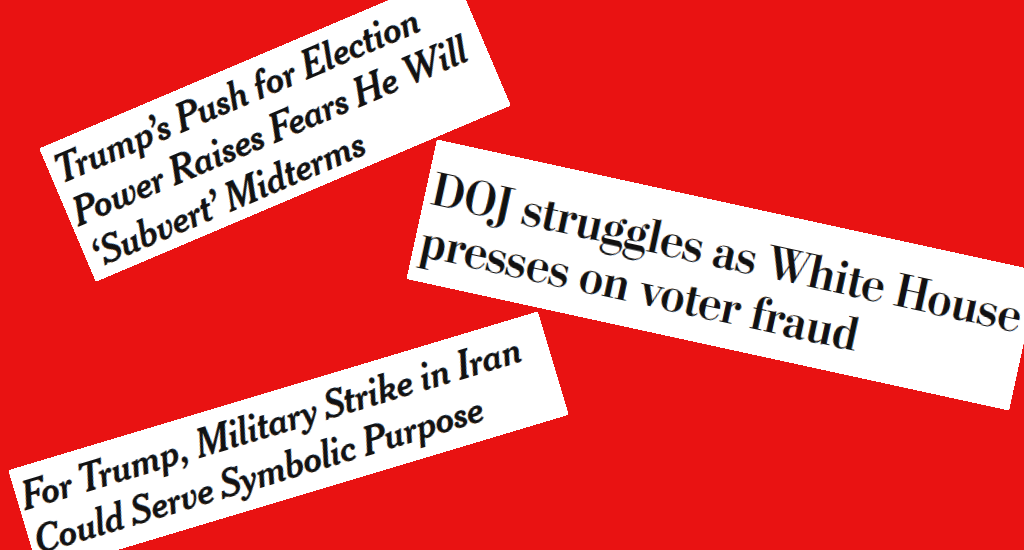
Here’s the headline on an article the New York Times published on Wednesday, by Shane Goldmacher and Nick Corasaniti: “Trump’s Push for Election Power Raises Fears He Will ‘Subvert’ Midterms.” The subhead is “The president appears to be undermining Americans’ faith in the outcome, at a moment when Republicans face an uphill climb to keep control of Congress.”
The first two paragraphs read as follows:
Ahead of the midterm elections, an emboldened President Trump has shown an increased eagerness to leverage the full investigative, prosecutorial and legislative powers of the federal government to bend election mechanics to his will.
With his words and deeds, the president — who pushed to overturn his 2020 defeat but declared his 2024 victory legitimate — appears to be undermining Americans’ trust that the midterms will be free and fair.
It’s an important story full of alarming facts.
But by choosing to put the word “subvert” in scare quotes in the headline, the Times telegraphed skepticism about the claim from the get-go. Similarly, the use of the word “appears” in the second paragraph is a mealy-mouthed hedge.
There are fears Trump will subvert the midterms. He is undermining Americans’ trust that the midterms will be free and fair. These are factual assertions. And yet the Times can’t even make them without scare quotes or hedging.
I would also question the use of the term “bend election mechanics to his will.” What does that even mean? If it means “impose his own rules about the way votes are cast and counted,” then why not say so?
The clause “who pushed to overturn his 2020 defeat but declared his 2024 victory legitimate” should instead have said: “who repeatedly tried and failed to steal the 2020 presidential election”.
And the third paragraph is a model of false equivalence:
As the political environment darkens for his party, Mr. Trump is again warning Republicans that Democrats are going to rig the results. At the same time, he is taking actions that make Democrats fear that Republicans are actually going to subvert the election.
It equates an accusation with no evidence to a concern that is supported by the article as well as historical facts. Ridiculous.
The Times on the Crusade to Find Noncitizen Voting
On Feb. 18, the New York Times published a story headlined: “Administration Targets Noncitizen Voting, Despite Finding It Rare.” It had five bylines: Glenn Thrush, Devlin Barrett, Alan Feuer, Zolan Kanno-Youngs, and Hamed Aleaziz. The subhead: “The intensified push is part of an extraordinary all-fronts effort to insert federal law enforcement into the machinery of American elections ahead of the midterms.”
The opening paragraph:
Homeland security officials, at the direction of the White House, are intensifying efforts to investigate voting by noncitizens in pursuit of President Trump’s baseless claims that illegal voting by undocumented immigrants is a rampant and insidious threat.
It’s a strong story, as far as it goes.
But it fails to address a key question: If noncitizen voting is a baseless nonproblem, they why are they doing this? If the move, as the authors state, is “part of an extraordinary all-fronts effort to insert federal law enforcement into the machinery of American elections ahead of the midterms,” then to what end?
The reporters leave readers a measly breadcrumb 20 paragraphs in, when they write:
The overall effort to enlist federal law enforcement in elections is being coordinated, at least in part, by Anthony Salisbury, a top deputy to Stephen Miller, Mr. Trump’s domestic policy adviser and the architect of the administration’s increasingly hard-line immigration crackdown.
Notably left unsaid to the reader is the fact that Miller is leading Trump’s white nationalist agenda — which very much includes disenfranchising nonwhite voters.
The first description of the White House’s sleazy agenda comes 26 paragraphs into the 31-paragraph article, but only attributed to “voting rights groups”:
The increasing involvement of H.S.I., an agency responsible for immigration enforcement, in elections has raised alarm among voting rights groups that believe it is part of a campaign to intimidate legal voting by immigrants.
Kristi Noem, the homeland security secretary, stoked those concerns when she recently said her goal in cracking down on voter fraud was to “make sure we have the right people voting, electing the right leaders to lead this country.”
And while I’m very glad they included Noem’s quote, I think “stoked those concerns” is too weak. How about “said as much” instead?
I’ll bet all five reporters on this story know full well what this is really all about: Trying to rig the election by blocking nonwhite people from voting. But not one of them was willing to say so.
The Post on the Poor Struggling DOJ
Similarly, on Feb. 20, the Washington Post published an article by Perry Stein, Patrick Marley, and Isaac Arnsdorf headlined “DOJ struggles as White House presses on voter fraud.” The subhead: “Efforts to prosecute noncitizen voters have been slowed by lack of evidence, officials say, while Trump aides push for a broader crackdown.”
The first paragraph:
The Justice Department has struggled to meet White House demands to prosecute noncitizen voters as conspiracy theories that President Donald Trump and his allies have pushed in public fail to hold up legally.
The seventh paragraph identifies DOJ’s dilemma:
The efforts so far haven’t yielded results, in large part because the types of rampant voter fraud that the Trump administration describes have never been found.
And nine paragraphs in, the authors quote a Democrat saying what they should have been comfortable writing in their own voice:
Nevada Secretary of State Francisco Aguilar (D) said… that Republicans’ focus on noncitizen voting is a “red herring” and “non-issue” that’s meant to dissuade Latinos and other voters from casting ballots.
“They’re trying to sow chaos into the process so it discourages people from participating,” he said.
Yes, that’s the story right there. Headline: “White House pressures DOJ to find crimes that don’t exist.”
Then the authors should have exposed the White House’s true motivations – in their own voice – and written at length about how utterly perverse and wildly dangerous it is for political appointees to send prosecutors out to find examples of a crime that doesn’t exist, when their job is to act on actual evidence.
Sadly, none of these failures surprise me. The push to suppress and control the vote has been central to the Republican agenda for a decade now, but as I wrote in 2021, our top political reporters cover it like it was any other partisan squabble, instead of calling it out as grotesque, racist, and anti-democratic.
But the lapses are not just about voting rights.
The Times on Trump’s Real Motives in Iran
The New York Times on Thursday published an article by Julian E. Barnes and Helene Cooper headlined “For Trump, Military Strike in Iran Could Serve Symbolic Purpose”. The subhead read: “Some officials in the Trump administration hope an attack would force Iran to give up its nuclear enrichment program. Others have doubts.”
This, it turned out, was a hugely important story. But they totally buried the lead.
The first paragraph, in fact, contained no news. It was basically a summary of David E. Sanger’s essential, if slightly overdue, news analysis from Feb. 20. (That one was boldly headlined “As Trump Weighs Iran Strikes, He Declines to Make Clear Case for Why, or Why Now”.)
Barnes and Cooper wrote:
The targeted strikes on Iran being considered by the Trump administration would probably be aimed at nuclear and missile sites in the country. But the president has yet to specify, to either the American people or the troops who would carry out his orders, exactly what he wants this military engagement to accomplish.
Again: Not new — but frankly, it’s a point that cannot be emphasized too much, so I didn’t mind. This would be an attack with no explanation and no debate. That’s crazy.
What the article’s headline hinted at in referring to a “symbolic purpose” only became clear in the seventh paragraph:
But any damage from a U.S. strike would more likely serve two symbolic purposes. Several administration officials said it would allow Mr. Trump to claim a military victory against an old foe.
In other words, it would make him feel good. It would make him feel better about himself.
That’s a startling, alarming, and disturbing conclusion. I’m glad they reported it. But it should have been in the lead. It should have been expanded upon. Historians should have been consulted. Foreign policy experts should have been asked to respond. The headline should have done more than hint.
The Times Normalizes Vaccine Lunacy
The New York Times published an article on Feb. 13 by Christina Jewett headlined “Kennedy Allies Target States to Overturn Vaccine Mandates for Schoolchildren.” Its subhead: “Proponents of vaccines warn that the efforts will further dismantle the immunization infrastructure and lead to more outbreaks of disease.”
It had a solid first paragraph!
Longtime allies of Robert F. Kennedy Jr., the nation’s health secretary, have launched a new effort to repeal laws that for decades have required children to be vaccinated against measles, polio and other diseases before they enter day care or kindergarten.
This was an important article about the clash between science, on the one hand, and obsessed conspiracy theorists who are effectively killing children, on the other.
But wait! That’s not how Jewett describes the two sides.
No, in her second paragraph she writes about “A newly formed coalition of vaccine activists” on the one side.
And when she finally gets around to what knowledgeable people say about it, she labels them “vaccine proponents.”
This is like writing about “gravity activists” and “gravity proponents” – except gravity is actually a theory and vaccine efficacy is a fact.
These people are lunatics. Everyone at the Times knows that. Hell, they’re a death cult.
By calling them “vaccine activists” the Times normalizes them.
And, in fact, that’s what all these examples have in common. They normalize lunacy and lying and criminal conduct.
Our top reporters frequently uncover shocking news about this deeply abnormal administration. But they evidently worry that being too blunt about what they’ve found would violate their newsroom culture, which prizes neutrality. They only tell part of the truth, and they count on the readers to fill in the blanks. They should be braver than that.