
The stunning collapse of a politically-motivated prosecution in Chicago, which came after a judge discovered that Justice Department lawyers had engaged in gross misconduct to secure a grand jury indictment, ought to be an inflection point for coverage of Trump’s DOJ.
The Chicago case makes for an extraordinary read. The “Broadview Six” were initially indicted on felony conspiracy charges for protesting outside an ICE facility. But all charges were dropped on Thursday after Judge April Perry saw a grand jury transcript that prosecutors had resisted turning over to her.
It contained numerous examples of misconduct, including a prosecutor personally “vouching” about the strength of the case. The defendants are now asking the judge to order prosecutors to preserve records of all their communications. It’s basically a huge mess and a vindication of the suspicion that prosecutors, under pressure from Washington, are abusing their power.
So how should this change news media coverage going forward?
Historically, charges emerging from federal grand jury proceedings have been seen to carry a certain amount of credibility. The presumption by reporters, and by the general public, has been that the prosecutor was acting in good faith and had presented clear evidence under a reasonable legal theory sufficient to persuade a bunch of ordinary citizens that the person was probably guilty — in short, that prosecutors had a serious case.
That presumption, to use a legal phrase, is now moot.
So from this point on, reporters should treat grand jury indictments – particularly in political cases — with great skepticism.
The thrust of their news articles – including their headlines – should be that the Justice Department has made a decision to go after the defendant, not that prosecutors have overcome any sort of significant legal hurdle. (“Justice Department goes after James Comey for seashell photo” rather than “Comey indicted on charges of communicating threats”.)
Reporters should also explain that grand juries have historically been highly susceptible to prosecution arguments – ergo their reputation as “rubber stamps” and the origin of the saying that “a prosecutor could get a grand jury to indict a ham sandwich.”
Reporters should provide background about Trump’s reforging of the Justice Department into a tool of retribution that routinely launches bogus investigations and prosecutions of people who have opposed him. They should note that prosecutors are under intense pressure to please the White House.
A rare bit of reassuring news is that grand juries still maintain the ability to reject – or “no bill” — a prosecutor’s case when it’s clearly nuts. That used to be extremely rare, but has become almost common in the Trump era, like the case of the sandwich guy, or the pursuit of six congressional Democrats who reminded servicemembers of their duty to refuse illegal orders, or several other failed attempts to indict protesters in Chicago.
So what explains the grand juries that went along with felony charge of conspiracy against independent journalist Don Lemon for covering a church protest? Or with charges against the Southern Poverty Law Center – a prominent civil rights organization – for wire fraud and money laundering for paying informants within the KKK and neo-Nazi groups? Or with the communicating-threats charges against Comey, for the seashells?
Given what happened in Chicago, reporters would actually be remiss if they didn’t raise the distinct possibility of grand jury manipulation – of conduct that goes beyond the legal and ethical rules prosecutors are supposed to follow.
And there’s another lesson from the Chicago case: Defense lawyers – and journalists – should demand and expect that the judges in these cases request a full transcript of the entire grand jury proceedings, and report back on any irregularities.
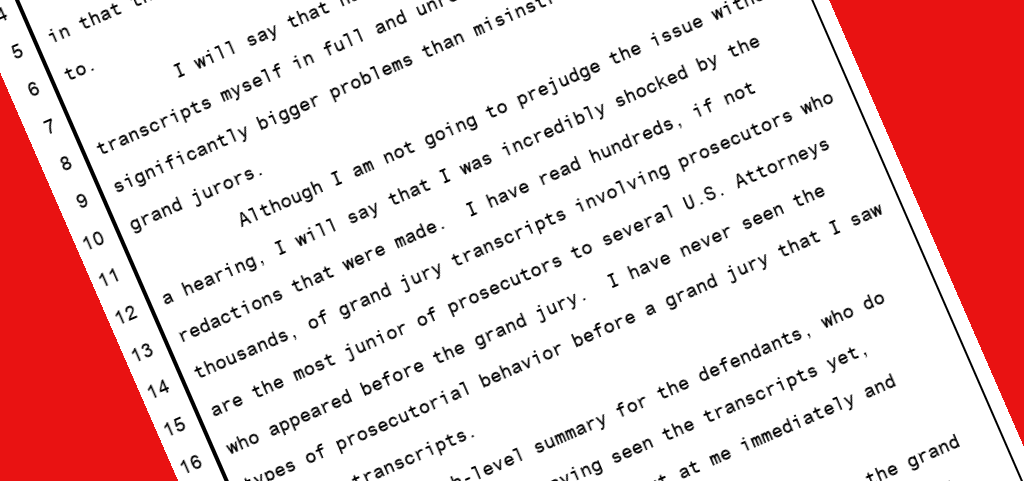
“I have read hundreds, if not thousands, of grand jury transcripts involving prosecutors who are the most junior of prosecutors to several U.S. Attorneys who appeared before the grand jury,” Judge Perry said during a hearing Thursday morning, according to a transcript. “I have never seen the types of prosecutorial behavior before a grand jury that I saw in those transcripts.”
And she told the defendants: “We all took the government attorneys’ word on a great many things. I, at the time, was operating on a presumption of regular grand jury proceedings, which these were very clearly not. So based upon what I’ve seen in the grand jury transcripts, the calculus has changed and it has changed considerably. So I also think you are entitled to a briefing and perhaps a hearing on the issue of vindictive prosecution should you choose to raise it.”