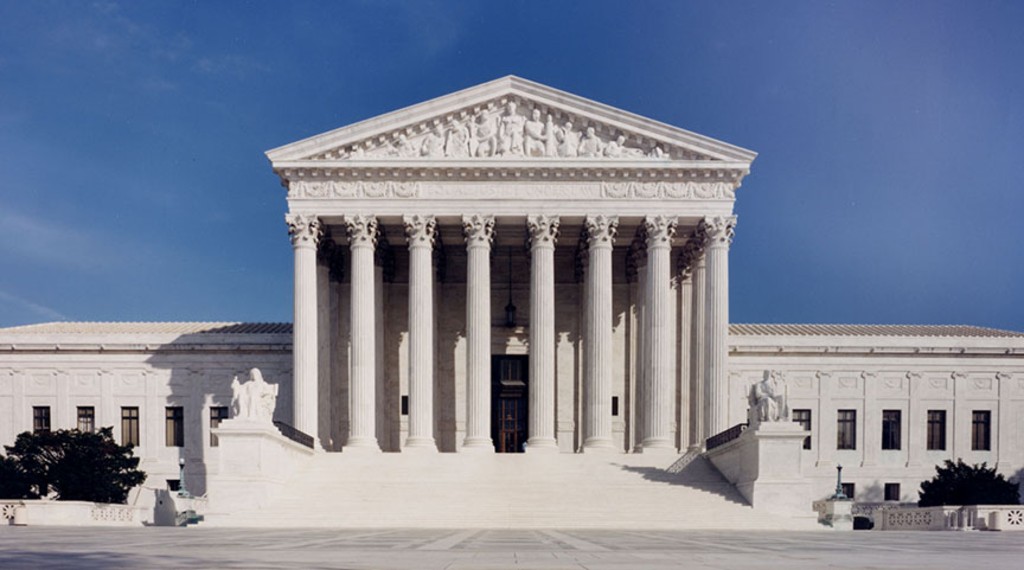

The legal and moral question at the heart of Thursday’s 6-3 Supreme Court opinion giving Donald Trump the go-ahead to deport over 350,000 mostly Haitian immigrants was a simple one: Was Trump’s decision motivated even in part by racial animus?
And that, in turn, came down to the question: Were Trump’s past statements about Haiti racist?
That is not a tough one.
Trump has accused Haitians of eating their neighbor’s pets. He has called Haiti a “shithole” country and has said he preferred immigrants from “nice” predominantly white countries. He has said that most Haitian immigrants “probably have AIDS.” He has said nonwhite immigrants are “poisoning the blood of our country.”
Even the mainstream political journalists who bend over backwards not to call Trump a racist outright have acknowledged that some of his comments about Haiti in particular qualify as racist smears and as elements of a racist and inflammatory narrative.
But after Justice Samuel Alito wrote in the majority opinion that none of Trump’s statements about Haiti were “overtly racial,” I had a bad feeling that our top political journalists would wimp out and treat Alito’s assertion as debatable – as one of two plausible sides of a political argument –- rather than as the bald-faced, ridiculous lie that it is.
I was worried that rather than state the obvious, they would throw up their hands and say, effectively, “You decide whether what Trump said is racist or not. You decide whether his statements on race represent reasonable, legitimate political discourse. We’re not going to judge.”
Readers, I was right to worry.
Our elite political media is now bothsidesing racism.
Most of the coverage of Thursday’s Supreme Court decision -– to the extent that it raised the issue of racial animus at all — consisted of, literally, both sides. Reporters briefly quoted Alito’s opinion, briefly quoted Justice Elana Kagan’s blistering dissent, and left it at that. Jump ball.
See the Associated Press, the Washington Post, and NBC Nightly News coverage, for instance. The CBS Evening News and ABC World News Tonight whiffed entirely on the racial element.
That was bad enough.
What was even worse was the New York Times “news analysis” headlined “Justices Clash on Whether Race Played a Role in Trump’s Bid to Deport Haitians.” In it, chief legal affairs correspondent Adam Liptak explicitly treated Trump’s obvious racism as an open question, with two sides.
Here’s the top:
The Supreme Court on Thursday confronted two questions that have also confounded many Americans for the past decade: How seriously should people take President Trump’s wild, coarse and ugly statements? And are some of them marred by racial animus?
Like the country itself, the court was deeply divided on both.
This is pure poppycock. The question about Trump’s racial animus has not “confounded” many Americans. His animus is on display almost daily.
Who thinks Trump’s “wild, coarse and ugly statements” are some sort of joke? Nobody.
Indeed, everybody in touch with reality knows very well that Trump holds “racial animus.” Even Alito and the five other Trump acolytes on the high court know that, they just choose to lie about it.
To the extent that the country is “deeply divided,” it is between a minority of people who share Trump’s views and an overwhelming majority (I hope) who don’t.
And that shouldn’t be a “both sides” issue. Journalists should have the integrity to call out racist language and racist acts by name, and to cast racism as a societal ill.
The coverage should have made it clear that Alito was making an indefensible argument.
Here’s what the top of my “news analysis” would have looked like:
The six hard-right justices who control the Supreme Court on Thursday gave Donald Trump the go-ahead to deport hundreds of thousands of legal Haitian and Syrian immigrants, insisting – against a mountain of evidence – that Trump’s decision-making was not even slightly motivated by racial animus.
The Opinion
If you haven’t read the key sections of Alito’s opinion and Kagan’s dissent, they are really worth your time. The opinion approves the termination of Temporary Protected Status (TPS) for immigrants from Haiti and Syria, taking away their legal status and making them subject to deportation.
In his discussion of Trump’s comments, Alito split hairs:
The President’s comments fall into four main categories. First, many express strong objections to the immigration that this country has experienced in recent decades and to many of the immigrants who have come here, particularly those who have come to or stayed in the United States illegally. These statements associate these immigrants with crime and other social ills. Second, some statements express great displeasure with TPS. They note, among other things, that TPS designations have often been far from temporary and that aliens who are allowed to stay in the United States under the program are not vetted like other aliens who seek admission. Third, some statements broadly denigrate the countries for which TPS designations have been granted—including Haiti—portraying them as hellish places in which to live. And fourth, some statements malign Haitians who have come to the United States.
Then he concluded:
None of the cited statements by either the President or the Secretary was overtly racial, and in substance all expressed policy views that could rest on race-neutral justifications. For example, one may oppose TPS and favor tighter restrictions on immigration for economic or other reasons that have nothing to do with race. And a person without racial bias can provide a harshly unfavorable description of living conditions in some of the countries with TPS designations. The criteria for TPS designations guarantee that many, if not most, designated countries have such characteristics.
Alito casually shrugged off Trump’s “heated language” as the new normal. (The case, Mullin v. Doe, was formerly known as Trump v. Miot):
In offering the cited statements as proof that the termination of Haiti’s TPS termination was motivated by race, Miot respondents seek to capitalize on the statements’ heated language. Political discourse by prominent public figures is increasingly couched in terms that would have scandalized the public just a short time ago, and the statements cited by Miot respondents—especially those concerning Haiti and Haitian immigrants to this country—exemplify this development. But whatever one may think of the cited statements, they are insufficient to show that the termination of Haiti’s TPS designation was based on the race of the Haitian people.
Interestingly enough, Alito personally distanced himself from Trump’s statements, expressing empathy for Haitians and writing that “there is no justification for denigrating the character of Haitians who suffer from and bear no responsibility for their country’s ills.”
I agree that there is no justification. But there is an explanation. And that explanation is that Trump is racist.
The Dissent
Kagan, in dissent, wrote that the Haitian plaintiffs had provided clear evidence that race played a role in Trump’s decision:
The evidence they have offered includes statements by the President so repellent and racially inflected that the majority declines to put them in print. (Indeed, one measure of the President’s way of speaking about Haitians is to compare it with the majority’s, which is unfailingly respectful.)
So here are some of those statements. Haitians are “eating the dogs . . . . They’re eating the cats. They’re eating—they’re eating the pets of the people that live [in Springfield, Ohio].” And: Haitians are also eating “other things too that they’re not supposed to be.” And: Haitians in the United States “probably have AIDS.” And:Haiti is a “shithole country,” which is “filthy, dirty, [and] disgusting.” And: Haitian immigration is “like a death wish for our country.” And: Haitians, along with some others, are “poisoning the blood” of our country. And: “Why is it we only take people from shithole countries” like “Haiti [and] Somalia”? “Why cannot we have some people from Norway [and] Sweden?”
The majority briefly replies that those remarks are not “overtly racial,” but it is hard to know what that means. Haitians are Black. (Norwegians and Swedes not so much.) The references—of filth, disease, and primitiveness—are shot through with racial stereotypes and tropes. It is hard to imagine the statements being made today of any White community. No very “sensitive inquiry” …. is needed to see them for what they are; judges, as we often say, are “not required to exhibit a naiveté from which ordinary citizens are free.”
The statements fairly shout, in their racial undertones and overtones alike, that race entered into the President’s resolve to remove Haitians from this country.
No reasonable person could read Kagan’s dissent and take Alito’s opinion at face value.
The Honest Takeaway
For an antidote to the mainstream media’s whitewashing of the racial issue, read Elie Mystal’s piece in the Nation, headlined: “The Supreme Court Once Again Endorses Trump’s Racism.” Mystal wrote:
Alito and the other Republicans on the Supreme Court have given constitutional protection to the openly racist and white supremacist policies of the Trump administration.
And he concluded:
The decision to ignore Trump’s racism means that the Republicans on the Supreme Court are racist. I don’t claim to know what’s in their hearts, but more to the point, I don’t care. I can see their racist actions. And their actions affirm, time and again, Trump’s own overt racial biases. It has been clear for a long time that that affirmation must be interpreted as an endorsement.
Matt Ford authored an excellent overview of the case for the New Republic, headlined: “The Supreme Court Backs Trump’s Gutter Racism.”
He wrote that “the court effectively blessed Trump’s bigotry toward Haitians and dealt potentially catastrophic damage to federal civil rights laws.” He called attention to the “echoes of Nazi Germany when the president says that a minority group is ‘poisoning the blood’ of our country.” And he concluded:
In the end, it comes as no real surprise that the Supreme Court’s conservative majority takes no issue with Trump’s description of Haiti as a “shithole country,” nor that it finds no racist motivation in describing Haitians as eating people’s pets or poisoning the blood of the American Volk. They don’t see Trump’s remarks or actions as racist because they apparently agree with him.
It’s the Whole Party
If you’re going to write about politics and racism, one of the most important stories to tell is that not just Trump, but the entire Republican Party – inspired and liberated by Trump — is becoming more and more overtly racist. And that includes the Republicans on the high court.
As I wrote in October, “It’s becoming increasingly clear that white supremacy is one of the core animating principles of the Republicans who control all three branches of government.”
Case in point, Rep. Tom Emmer of Minnesota, who as majority whip is the third-ranking Republican in the House, proudly acknowledged overtly racist views on Thursday at a Faith and Freedom Coalition event on Capitol Hill.
“Minnesotans are so afraid that you’re gonna call us a racist, you’re gonna call us an Islamophobe…. You know what?… I’m done being careful, even the least bit careful,” he said. Somalis “don’t assimilate,” he said, “And if they don’t assimilate, then they should go the hell back to where they came from.”
This is a change. Ten years ago, Emmer was bragging about how quickly Somalis assimilated and saying he supported them “wholeheartedly.”
Racism is now rampant in one of our two political parties. But that’s not an excuse for journalists to treat it like an issue with two legitimate sides -– or to cover it up.
This number of journalists willing to stand firm for what is right, what is just, and what is true is vanishingly small. I’m gratified I can still find and read you. I’m heartbroken it has become so challenging to do so. Elie Mystal’s piece yesterday was a cri de cœur that should have resonated widely in its moral clarity. No matter. That which is right remains right. That which is just remains just. That which is true remains true. I do not look to the sadistic six for validation of natural rights.
I completely agree with the conclusions in Mystal’s piece referenced above about the overt racial animus of the Republican members of SCOTUS, the party as a whole, and of course the despicable current leader of that party. Beyond that, what to me is exceptionally disheartening is the bedrock of support this morally vacuous party continues to garner. White supremacy is a cancer on the body politic that clearly survived the Götterdämmerung of the previous world war and has reared its ugly head here and in other places as well, and has found a receptive demagogue in this country to normalize it and spread its sickness.