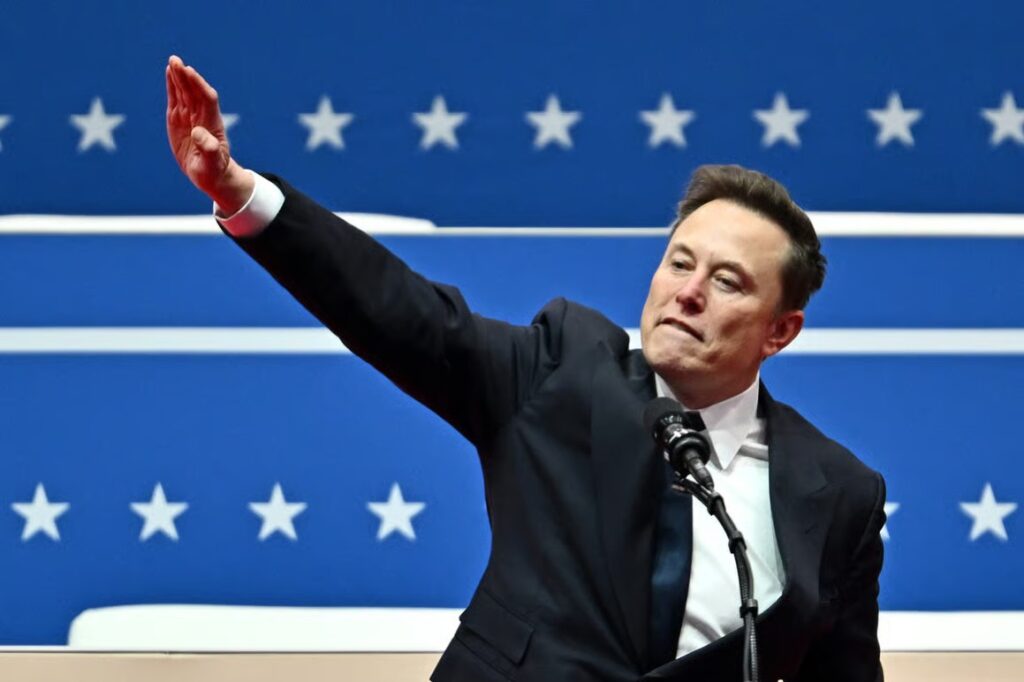

Elon Musk went public on Wednesday with the news that he intends to spend at least another $100 million of his own money to help Republican candidates in the November midterm elections.
The news coverage dutifully noted that the richest man in the world would once again be the largest Republican donor.
But it left out another key superlative: Musk is also the world’s most vocal white supremacist and advocate of ethnic cleansing.
Something about that ought to have been at the top of the articles. But it was nowhere.
So why do our top news organizations consistently fail to mention this very obvious and important fact when they write about him?
Major credit to Jamelle Bouie – the astute New York Times columnist who often brings clarity to the murkiest political issues – for raising that question in his latest column, headlined “Why Do We Tolerate Elon Musk’s Racist Commentary?” (That’s a gift link.)
“With hundreds of millions of followers on a platform he personally controls, Musk stands as the most prominent purveyor of far-right and ultranationalistic rhetoric in the world,” Bouie wrote. “This is the same Musk who is also busy leveraging his vast wealth to shape that same world in his own image.”
So, Bouie wrote:
If there is a question to ask, then, it is this: Why does Musk get a pass? Why do politicians, journalists and commentators treat his far-right racist radicalism as a sideshow rather than the core of his political, ideological and industrial project, seen in everything from his deep support for Donald Trump in the United States and Restore Britain in Britain to his decision to construct a massive pollution-generating data center in predominantly Black Memphis?
It’s Not Hidden
Musk famously bought the social media site formerly known as Twitter four years ago for $44 billion, turning into a massive repeater of disinformation and hate speech.
Now, on a daily basis, he blasts his 240 million followers with supremacist messaging. He bemoans the status of white people as a “rapidly dying minority,” and agrees that white people can either be “conquered, enslaved, raped, or genocided” or “reclaim our nations and our dignity.” He promotes “remigration,” a particularly depraved call to forcibly remove all nonwhites from white-majority countries.
Most recently, he has been using imagery from a racist vigilante movie to endorse killing “first the traitors then the invaders.” And he has tweeted that “Anyone who opposes remigration is a traitor.”
But It’s Not Stated
The press does, indeed, give Musk a pass for his vile views. Consider the coverage this week of his plan to spend another $100 million or more on the 2026 midterms. (According to the Washington Post, he’s already spent at least $90 million.)
Alex Isenstadt of Axios broke the story, reporting that “Tech billionaire Elon Musk is jumping into the midterms with a huge investment in a plan to boost Republican voter turnout, Axios has learned.”
He noted that Musk’s 2024 donations “made him the largest individual political donor in a single election cycle in U.S. history,” And he reported that “Musk, the world’s richest person, has been in talks with Trump’s team about how he can help.”
The only relevant background he provided about Musk was that he “had a falling out with Trump after a four-month stint leading DOGE…. But his relationship with the president has warmed somewhat over the last year, and by the end of 2025 he was back to contributing to the GOP.”
In the New York Times, Theodore Schleifer reported that “Elon Musk, a year after voicing deep frustration with the Republican Party and threatening to start a third party, appears to be back in the fold and prepared to spend big in the midterms to help G.O.P. candidates.” No mention of his racist views, just an acknowledgement that “Mr. Musk’s interest in, and commentary about, politics can seem erratic.”
The closest CNN came to acknowledging Musk’s bigotry was, ironically, in this reaction from pro-Trump panelist Scott Jennings. “Thank god,” Jennings said about Musk’s donating plans. “Given the stakes of this election and given the fact that Western civilization is on the ballot — and I know how much he cares about that — I’m glad to see him come back to the Republican Party.”
One journalist that I know of has raised the issue directly with Musk: Zanny Minton Beddoes, the editor of the Economist, who had a rare interview with Musk earlier this week.
Toward the end of the interview, Beddoes characterized Musk as “an ongoing participant in the worst kind of tribalism – uh, you know, cesspit of social media.” She said that “people say that you’re a racist,” then asked “what is the motivation for doing that?”
“My partner is, she’s half-Indian, and I have four children with her,” Musk replied, establishing nothing. “One of them was named after a famous Indian physicist. So I would say I’m not racist And also if you look at the people that are employed at my companies, we have senior executives of all races. I don’t think there’s any racism there.”
He was considerably more revealing when Beddoes asked if he is anti-Muslim: He didn’t deny it.
“I am against having — if people are coming to a country with antithetical views I am against that. I’m against — I’m against rape and murder,” he said. “I’m against the imposition of rules and laws that are contrary to what we’ve come to accept in the West. And I think it’s a crying shame that the sort of traditional media like you don’t recognize this.”
Afterwards, Musk tweeted that Beddoes was “a traitor to the West, plain and simple.“
So What’s the Answer to Bouie’s Question?
Bouie did not answer his question in his column. But Chris Hayes had him on MS Now on Thursday night, and this time, Bouie speculated on some of the possible reasons Musk gets a pass.
“Perhaps it’s because people think it’s, you know, not appropriate to call this stuff out? Perhaps because they think it sounds like you’re being hysterical if you call this stuff out,” Bouie said.
He continued: “Part of me wonders if this isn’t part of maybe a larger pathology in political media, which is that Democrats haven’t made hay of this, right? And so if Democrats don’t make hay of it, there’s sort of this thing where, ‘Oh, well, we’re not going to make hay of it on their behalf’.”
But Bouie said of this second possibility: “I don’t even find it that persuasive because… if there were a DSA [Democratic Socialists of America] member who said anything, even remotely as reprehensible as Musk says on the regular, every Democrat in the country would have to answer whether or not they agree with it… I find this so strange.”
And he noted, “these views aren’t just a quirk that Musk has, but have like material effects in the world. The destruction of the United States Agency for International Development last year by Musk is estimated at this point to have claimed up to 700,000 lives, largely in places like Sub-Saharan Africa. And to my mind, it’s hard not to see a connection between his enthusiasm for destroying programs like USAID and his views.”
I Have Some Thoughts
I firmly agree with Bouie’s first theory: That our elite political journalists would worry about being seen as hysterical if they did something like call out Musk’s racism. So they don’t.
The fact is that sounding in any way hysterical – i.e. alarmed, and passionate about anything — in a major corporate newsroom is a ticket to finding yourself off the politics beat. And that could certainly include insisting on noting Musk’s racism in any article about him.
As I’ve written many times over many years, newsroom leaders are violently opposed to the appearance of “taking sides” on what they consider a contentious issue. (That even applies to issues like democracy or press freedom; don’t get me going.)
And they believe that calling out racism where it exists — or overtly calling someone who is racist a racist — is legitimately contentious, or at least inflammatory. Push for that too hard and you’re hysterical.
The other factor here is a decades-long history of race being a particularly fraught topic in our major newsrooms. It is a central issue in American politics and our history, but is has also often been a journalistic blind spot — partly because it is so complex, partly because of denial, and partly because of the intractably white gaze of our newsroom leaders.
I have documented many times recently when the Washington press corps has euphemized, overlooked, or actively covered up racist themes, even when addressing them head-on was in my view a journalistic and ethical priority.
- In June, the question of whether some of Trump’s past statements were “marred by racial animus” was at the heart of 6-3 Supreme Court opinion on deporting Haitian immigrants. That’s not a tough question. But Adam Liptak wrote in the New York Times that “the country” is “deeply divided” on it.
- In May, most of the media treated the suppression of Black voting power through redistricting in the South as just another partisan issue.
- In 2024, political reporters ignored the role racism played in Trump’s re-election.
- In 2023, journalists were euphemizing the negation of Black and brown experiences as part of a “culture war” debate.
- In 2022, I wrote about how the spread of white replacement theory offered journalists an easy litmus test for whether someone is racist or not. But political reporters didn’t call out its purveyors as obvious bigots, and over time it became a staple of Republican politics.
- In 2021, I wrote about how the media was ignoring the fact that the Capitol was left undefended because the Jan. 6’ers were white.
It Can Be Done (Sorta)
Washington political reporters are not incapable of calling out racism when it slaps them in the face (at least some of them.) After a 2025 Oval Office visit by South African President Cyril Ramaphosa, Zolan Kanno-Youngs of the Washington Post wrote a news analysis describing Trump’s conduct as “a vivid demonstration of Mr. Trump’s views on race, which have animated his political life going back years.” The article continued:
After rising to power in part by framing himself as a protector of white America, Mr. Trump has used his platform, in this case the Oval Office, to elevate claims of white grievance.
For Mr. Trump, white people are the true victims; Black people and minorities have received an unfair advantage in the United States. And when Mr. Trump looks to South Africa, a majority-Black country emerging from a legacy of apartheid and colonialism, he sees white people who need sanctuary in the United States.
Even that was understated, but it was something!
And yet, as happens so often, this one news analysis was the exception that proved the rule. No language like that ever appears in the day-to-day articles about Trump and racial issues, in the Post or any other major corporate news source.
Instead, our newsrooms cover up for Trump, avoiding any suggestion of racism even when he does things like blame diversity hires for an airplane accident.
In another exception, Faiz Siddiqui and Jeremy B. Merrill wrote in the Washington Post in April about Musk’s increasingly frequent “racial” (not racist) “rhetoric.” They noted that he was “rallying White people to stand up for their race” and that his “recent posts about race could strengthen his reputation as a divisive political figure.”
Again, not bad! But that element of Musk doesn’t – and won’t — get a mention in the routine Musk coverage, even about his political role.
Overall, as I wrote in October, the media has willfully overlooked the essential fact that white supremacy is one of the core animating principles of the Republicans who control all three branches of government.
So why should it be different for Musk? Just because his tweets spell it out so clearly?
Don’t be hysterical.