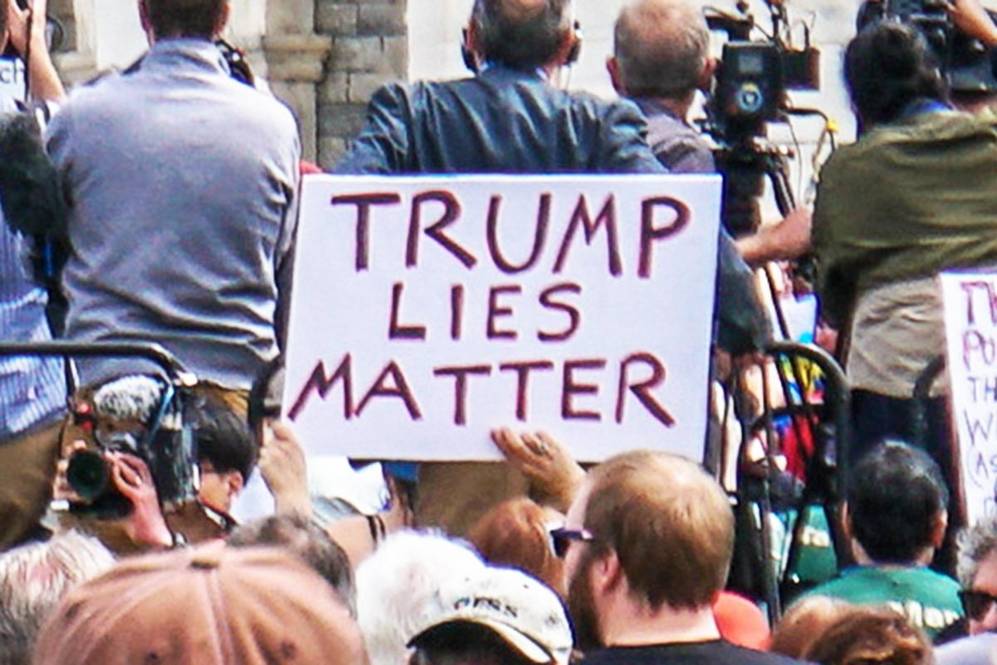

For a while now, I’ve been imploring the leaders of our top news organizations to call out Donald Trump’s derangement. My argument is simple: It is the central, underlying explanation for everything else they’re covering.
They won’t do it. Their arguments: It would appear partisan; We don’t want to take sides; And (more reasonably) we prohibit the use of language associated with mental illness unless a person has been diagnosed as mentally ill. (I wrestle with a variation of this last one myself: How do you call him insane without stigmatizing insane people?)
But it seems to me there is one thing any thinking journalist should be able to agree on: that Trump is untrustworthy.
This cannot be seriously in doubt.
Just for starters, news reports have amply documented that he lies constantly, he contradicts himself often, and he not infrequently does the opposite of what he said he would do.
That has been clear for a long time. But it has never been clearer than it is now, as he bloviates and flip-flops while incompetently commanding a brutal, deadly war that he promised never to start.
My message to newsroom leaders is this: If you quote Trump in a way that suggests that what he says is accurate or represents some sort of commitment, you are deceiving the people who count on you to tell them the truth.
And don’t just assume that everyone realizes he may well be lying. (If it’s so obvious, why are you afraid to say so?) You have to warn them every time. Maybe a standard disclaimer, maybe something related to the specific issue. Things like:
- “Trump’s previous statements about the war, including why he started it, have been erratic and contradictory.”
- “Trump, who has repeatedly proven that he is untrustworthy, ….”
- “Keep in mind: Trump consistently lies about the state of the economy.”
- “Trump makes many false claims each day, either out of mendacity or delusion.”
- “Trump is a primary source of U.S. disinformation.”
- “Trump has cited an arsenal of lies and distortions to justify significant policy changes on the economy, immigration and deployments of the military.” (Almost verbatim from a New York Times article.)
Consider using “claimed” instead of “said”.
Surround his lies with clear statements about reality – the “truth sandwich.”
And explain why he’s being deceitful – the “why behind the lie.”
His about-faces on such issues as tariffs and Iran have created chaos in the financial markets. How about interjecting some skepticism when he says something absurd in the first place, so that people won’t overreact when he says it – and again when he takes it back?
And have some self-respect. One of Trump’s most consistent messages to his supporters has been to mistrust the mainstream media and its “fake news.” But the primary source of “fake news” in the mainstream media is news reports based on Trump’s lies. So stop doing that.
And Now, War
Trump’s mendacity about the reason and goals for his unjustified and Iran have called attention to the cost — and the centrality — of his untrustworthiness.
The New York Times editorial board — which in this case I believe reflects what its news side would report if it were being honest – wrote last week about this very topic:
Lying is standard behavior for Mr. Trump, of course. His political career began with a lie about Barack Obama’s birthplace, and he has lied about his business, his wealth, his inauguration crowd size, his defeat in the 2020 election and so much more…. Many people are so accustomed to his lies that they hardly notice them anymore.
Yet lying about war is uniquely corrosive. When a president signals that the truth does not matter in wartime, he encourages his cabinet and his generals to mislead the country and one another about how the war is going. He creates a culture in which deadly mistakes and even war crimes can become more common. He makes it harder to win by hiding the realities of conflict and by making allies wary of joining the fight. Ultimately, he undermines American values and interests.
The editorial concluded:
Starting a war is the most serious action that a political leader can take. It ends lives and can change history. The decisions that guide war must be based in reality, and presidents owe American service members and their families the truth about why they are being asked to fight. Whatever short-term gain Mr. Trump thinks he is getting by lying about the war in Iran is far exceeded by the cost, for him, the country and the world.
Trump included a message to the Iranian people in his Feb. 28 statement announcing the war. “When we are finished, take over your government. It will be yours to take,” he said. On March 6, he said that the United States must be involved in choosing the next leader of Iran and posted on social media that “There will be no deal with Iran except UNCONDITIONAL SURRENDER!”
By contrast, intelligence reports have concluded that Iranian protesters would “get slaughtered” if they take to the streets.
And Trump today is claiming that the U.S. and Iran are in “productive” talks toward a “complete and total” resolution of the war.
As a result, he said, he won’t “obliterate” Iran’s power plants, as he had claimed on Saturday that he would do if the Strait of Hormuz isn’t reopened immediately.
Iran denies any such talks are taking place, so Trump could well be lying about that, too.
And now the Israelis, who were the only people happy with how the war was going, are getting the full Trump effect.
The Times of Israel reports that “Jerusalem was caught off guard by the announcement from the mercurial president.” It concludes: “Israelis who had trusted the plan now fear there is no plan and wonder if Trump can still be trusted.”
Global Effects
Trump’s untrustworthiness has led to a collapse in political trust between Washington and its allies, as Anne Applebaum writes in the Atlantic:
Donald Trump does not think strategically. Nor does he think historically, geographically, or even rationally. He does not connect actions he takes on one day to events that occur weeks later. He does not think about how his behavior in one place will change the behavior of other people in other places.
He does not consider the wider implications of his decisions. He does not take responsibility when these decisions go wrong. Instead, he acts on whim and impulse, and when he changes his mind—when he feels new whims and new impulses—he simply lies about whatever he said or did before.
She concludes:
If allied leaders thought that their sacrifice might count for something in Washington, they might choose differently. But most of them have stopped trying to find the hidden logic behind Trump’s actions, and they understand that any contribution they make will count for nothing. A few days or weeks later, Trump will not even remember that it happened.
New York Times global affairs correspondent Damien Cave wrote a devastating article headlined “How Trump Supercharged Distrust, Driving U.S. Allies Away.”
He wrote it a year ago. Back then, the issue was largely related to tariffs:
His own distrust of allies, evident in his zero-sum belief that gains for others are losses for America, has been reciprocated. What it’s created is familiar — a distrust spiral. If you think the other person (or country) is not trustworthy, you’re more likely to break rules and contracts without shame, studies show, reinforcing a partner’s own distrust, leading to more aggression or reduced interaction….
Experts said it would take years and a slew of costly trust-building efforts to bring America together with allies, new or old, for anything long-term.
This lost of trust could well extend the war, as Steve Dunne, a researcher at the University of Warwick in the UK, writes for The Conversation:
Without trust, negotiation itself becomes an impossibility. And if trust is consistently broken, even those predisposed towards cooperation will be deterred.
He concludes:
American reliability must now be broadly questioned, from collective security to the rule of law. The effect of this widespread loss of trust – embodied by Trump’s indiscriminate and ill-mannered economic attacks – will be the neutering of US soft power.
And going forward, nothing erodes public trust like a war full of lies, as Princeton history professor Julian E. Zelizer writes for Foreign Policy:
After President Donald Trump launched a major military attack on Iran in conjunction with Israel without providing a consistent rationale and without making a public case to Congress, it seems safe to say the result will be a further erosion of public trust in the federal government.
He concludes:
Despite the strong incentives to say whatever is necessary to legitimate military operations, the lies will be exposed over time. Presidents cannot ignore the long-term costs that result from dismissing the truth in pursuit of national security.
Whether Trump is actively lying, or whether he’s delusional – or whether his thinking process is simply so chaotic and unreliable that reality has no bearing on it whatsoever – there’s simply no possible reason to trust what he says.
And yet the elite media still more often than not treats his words as if they were coming from a normal president: Dutifully and stenographically.
I don’t know how many times I have fruitlessly called for an end to media’s normalization of this very damaged and disturbed man.
But here is one step in that direction that shouldn’t feel radical: Just make sure your readers and viewers realize he can’t be trusted to be telling the truth.
Tell the truth yourself.