
Any thinking journalist is aware by now that when Donald Trump says something – especially about the war in Iran – it may or may not be true. (And probably isn’t.)
This has been well documented. Consider the April 29 Washington Post article headlined: “Trump’s statements on Iran increasingly contradict each other,” or the May 6 Associated Press article headlined “Trump administration sows confusion as it tries to reopen Strait of Hormuz,” or the May 18 New York Times article headlined “Trump Threatens Iran and Then Pulls Back, All in the Same Day.”
So why in the hell did we spend the whole Memorial Day weekend being pummeled by news headlines about Trump’s Iran “deal”?
Trump posted a typically undependable statement on Saturday afternoon, full of weasel words. “An Agreement has been largely negotiated, subject to finalization,” he wrote. “Final aspects and details of the Deal are currently being discussed, and will be announced shortly,” he wrote, adding: “the Strait of Hormuz will be opened.”
What did our top journalist do? Did they respond with skepticism? Did they push back? Did they demand evidence? Did they warn their readers that Trump has zero credibility on this issue? (To be clear: The man has been saying the war would be over “very soon” for going on two months now.)
No. This is what they did:
- NYT: “Trump Says Peace Deal Is Near.”
- WaPo: “Trump says Iran ceasefire deal in final stages, to be ‘announced shortly’”
- CNN: “Trump says agreement with Iran has ‘been largely negotiated’ and Strait of Hormuz will be opened.”
- AP: “Trump says a deal with Iran and opening of Strait of Hormuz are ‘largely negotiated’
Where was anything remotely like a warning to readers that he might be full of it? I found them in places like the 14th paragraph, the 18th paragraph, and the fifth paragraph. It was entirely missing from the Post story.
As the weekend progressed, the coverage became a bit more skeptical. It had to, as Iranian officials confirmed essentially none of Trump’s claims, describing a very different emerging agreement than the one anonymous U.S. officials outlined. The only actual points of agreement appear to be that they are punting the tricky bits until later and that the Strait of Hormuz may be reopened soonish under unspecified conditions.
But even as days passed, with lots more headlines, readers weren’t being told the truth.
What did the Wall Street Journal do when it realized that there was no sign of an actual agreement on the most contentious issues? It published an article on Monday headlined: “Iran Talks Bog Down Over Nuclear Program and Sanctions Relief.”
And to add insult to injury, most news organizations treated as serious Trump’s deranged demand that, as part of making peace with Iran, every country in the region must join the Abraham Accords — which would entail making peace with Israel.
Reporters enthusiastically tried to match and beat an Axios article which, notably, reported that when Trump announced his demand on a Saturday phone call with the leaders of eight countries in the region, there was dead silence on the phone. “Trump joked and asked if they are still there,” a U.S. official told Axios’s Barak Ravid.
“I am mandatorily requesting that all Countries immediately sign the Abraham Accords,” Trump ranted on social media on Monday. And yet the Times treated the idea respectfully, noting that it was “unlikely” that any country would agree, but in no way even hinting that the idea is utterly insane.
When the U.S. launched military strikes against targets in southern Iran on Monday, too many news organizations credulously quoted officials who called them “self defense.”
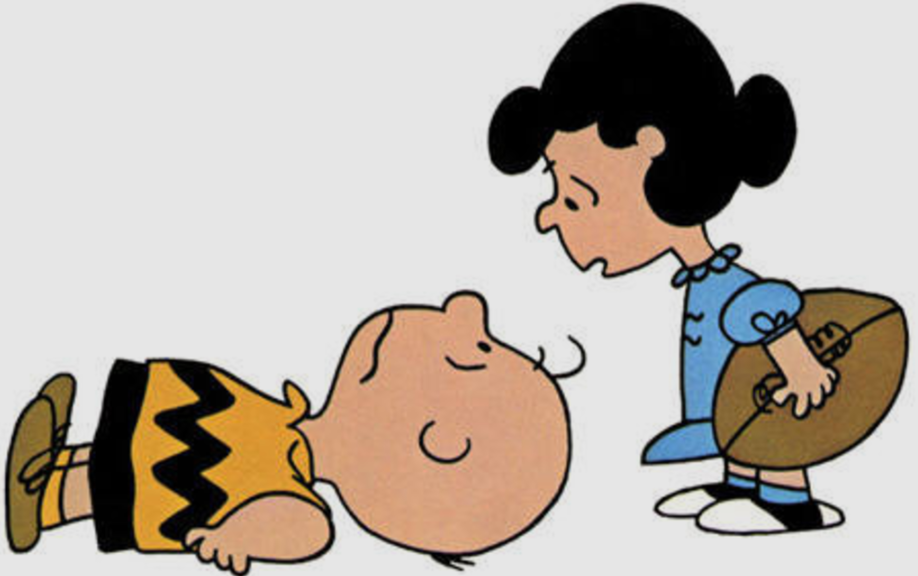
What’s so frustrating about the coverage this weekend is the Charlie-Brown-and-Lucy’s-football nature of the whole thing. How many times will reporters fall for this stuff? How many times must we go through this? It’s painful. Or as Charlie Brown would say: “AAUGHH!”
By now it should be clear that Trump’s assertions about the war in themselves mean nothing. Reporters should demand evidence before broadcasting them. And the coverage should reflect the reality that Trump is saying things that may or may not be true, and that he might contradict himself at any moment.
That’s not the stuff of a sidebar. And a warning to readers that Trump’s statement cannot be taken at face value shouldn’t be in the 14th, or 8th, fifth, or even second paragraph of the main story. That is the main story.
So how should Trump’s statements have been covered? I have some ideas:
- “Trump’s Claim that Iran Deal Is Imminent Raises Familiar Doubts”
- “Trump Makes a Vague New Claim About Iran”
- “Trump Makes a Dubious Claim About a Peace ‘Deal’ in Iran”
- “Trump Makes New Promises About Ending the War”
- “For Third (Fourth? Fifth? Sixth?) Time, Trump Says Strait of Hormuz Will Open Soon”
My message to our major newsrooms is simple: Have some self-respect.