
For nearly two weeks now, protesters have been trying to call attention to what’s going on inside Delaney Hall, a privately-run prison in Newark where immigrants – some of whom are on a hunger and labor strike – are being held without legal recourse in inhumane conditions.
But what little national coverage there has been of Delaney Hall has focused mostly on what’s going on outside, instead. And as if that weren’t bad enough, most journalists got the story completely wrong.
Our leading news outlets almost without exception described what was going on outside over the last two weeks as protesters “clashing” with police. They regurgitated preposterous official government statements. Their reporters either weren’t there, or they left when someone in a uniform told them to.
The best way to figure out what was really going on was to watch the livestreamed coverage from independent outlets Status Coup News, BG on the Scene, and Mercado Media.
And what was really going on outside Delaney Hall was that government authorities – first ICE, and then, shockingly, the New Jersey State Police under the control of a Democratic governor – engaged in violence against almost entirely peaceful protesters. They violated the First Amendment rights of people upset that human beings who did nothing illegal are being held without due process and being fed maggots.
(I’m writing this in the past tense because Newark Police took the lead role on Monday, and the past two nights have been free of violence.)
During the first week of protests, ICE agents routinely responded to isolated incidents – such as protesters blocking vehicles – with melee tactics, wantonly shooting people in the face with pepper spray, lobbing tear gas grenades, and wildly swinging their batons at demonstrators.
On Friday evening, New Jersey Gov. Mikie Sherrill sent the State Police to take over from ICE agents, precisely because she recognized that they were the aggressors.
“We’ve seen increasing violence, arrests, and pepper spray at Delaney Hall, as well as public threats from the Trump administration. And we’ve seen the risk to public safety rising outside of Delaney Hall,” she said. “It has grown unsafe and that’s completely unacceptable.”
She later explained: “They used batons, they used rubber bullets and measures that we felt like were escalating in violence. We saw I think someone being beaten by an ICE agent. That is not how we conduct our policing. This is not a law enforcement agency we want on our streets in any way.”
By contrast, Sherrill announced on Friday that troopers would establish “peaceful” protest zones to “protect” demonstrators.
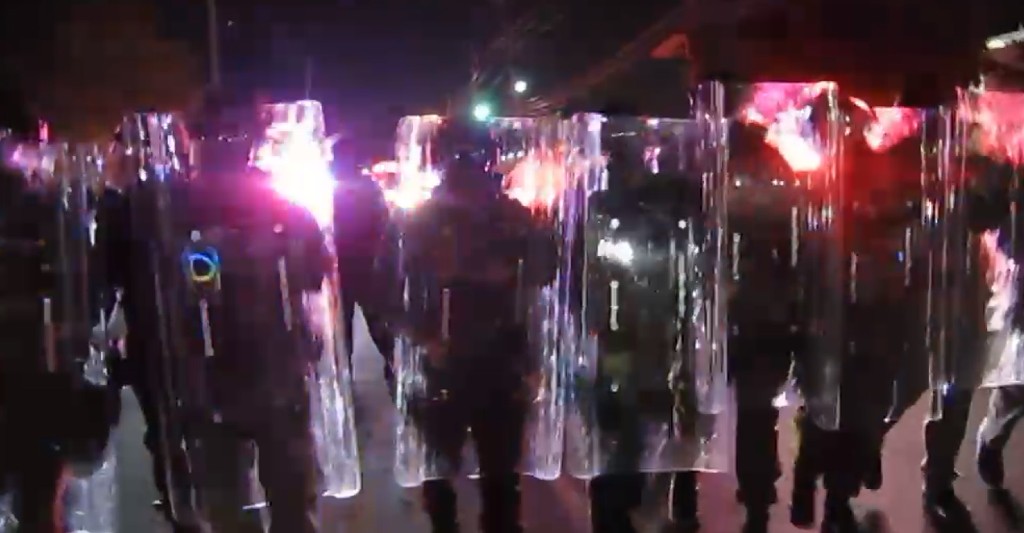
But within hours of their arrival on Friday night, state troopers in riot gear and on horseback were firing tear gas and shooting pepper spray at protesters.
New Jersey Attorney General Jennifer Davenport on Saturday blamed the violence on a “limited number” of protesters who refused to clear a pathway for vehicles, then “took dangerous actions, including deploying fireworks and throwing gas canisters at law enforcement, that put everyone in harm’s way.”
But protesters challenged that narrative, NJ.com reported, “alleging the state immediately went after the entire protest, including an area for water and medical supplies.”
Indeed, there were no “gas canisters” for protesters to throw (or kick) until after the troopers started using them. And there were no confirmed reports of fireworks.
The ACLU of New Jersey on Saturday called the state police’s actions “an unnecessary response to free speech and the right to peaceful protest” and said the state should “not mimic the dangerous and overly militarized tactics of the federal government.”
On Saturday night, Sherrill made a further mockery of her own “peaceful protest zones,” as state troopers in riot gear fired tear gas at protesters and pushed them more than half a mile away from the facility.
The single most overt violation of protesters’ First Amendment rights ended up coming from an unexpected source: Newark’s progressive Mayor Ras Baraka, the outspoken critic of Delaney Hall who a year ago was himself arrested in the facility’s parking lot on bogus trespassing charges. Early on Sunday, he announced a curfew for the area around the hall, effectively banning protest from 9 p.m. to 5 a.m.
When the curfew began on Sunday night, several dozen protesters chose to remain – entirely peacefully. They were confronted by several hundred state troopers in riot gear, who shot at least two people with rubber bullets, kettled the protesters, and eventually arrested 61 people, including at least two credentialed photojournalists. The “clashes” were entirely one-sided.
The attorney general then sent out a preposterous statement, blaming protesters for putting the public “at risk” because some of them “had come to the protest armed with helmets, shields, or gas masks.” Yes, she used the word “armed.”
The AP, the Guardian, and CBS all used that quote straight — with no disclaimer of any kind.
And yes, despite the entirely peaceful nature of the protesters’ conduct on Sunday, none of the coverage I saw correctly identified the aggressors. CBS reported that “protesters and New Jersey State Police clashed again Sunday night.” And the Guardian declared: “Several protesters arrested at New Jersey ICE facility as clashes continue.”
Baraka, on Monday, called the state police tactics over the weekend “overly aggressive, unnecessary and in some cases, unconstitutional.” He sent Newark Police officers – notably not in riot gear or on horseback — to take over from the state troopers. And as a result, Monday night was peaceful.
On Tuesday, he lifted the curfew. And Tuesday night was peaceful.
There’s a lesson there.
Look, I’m not saying that all the protesters behaved perfectly. One protester was charged with kicking and biting ICE officers on Thursday; another faces federal charges after he threatened to murder an ICE officer and his family on Wednesday, after the ICE officer hit him with a baton.
On Friday night, someone dropped a cinderblock on the windshield of an ICE vehicle. On Saturday night, something – possibly a flash-bang grenade – set off a fire in a roadway, and protesters stoked it. There was a lot of ugly smack talk.
But it was ICE that escalated, just as Sherrill said. And then it was Sherrill’s state troopers who donned riot gear and were overly aggressive, as Baraka said.
The coverage should have reflected that. (The coverage should also have explored the bizarre phenomenon of Democratic state officials decrying ICE but then doing their dirty work for them.)
And the coverage should have focused on what was really at stake.
As I wrote last June, reporters covering any protest shouldn’t obsess over clashes and arrests. They shouldn’t rely on what government officials tell them. They should listen to the protesters, and tell us why they’re there and what they want.
In this case, as I wrote last week, journalists should be using the protests as way of exploring and exposing the maltreatment of immigration detainees. Indeed, as I wrote in February, reporters have failed to raise essential questions such as: Why does someone who isn’t a flight risk need to be indefinitely confined in a filthy overcrowded cell?
When protesters engage in violence, reporters should specify if it was aimed at property or at people. They should ask: Was law enforcement’s use of force proportional? What were the rules of engagement? Did they use “less than lethal” weaponry in a responsible or irresponsible manner? Reporters should talk to victims about what they were doing before they were injured.
And they should recognize that heavily armed and armored law enforcement officers are often the cause of violence, not a response to it.