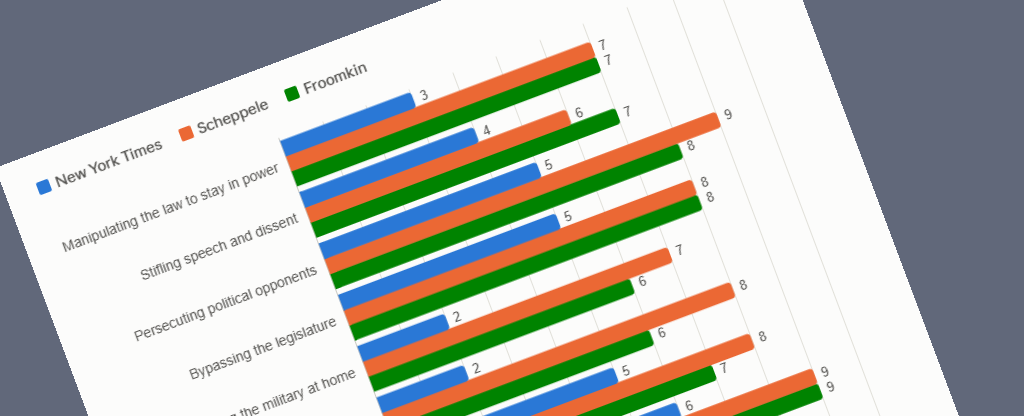

The New York Times editorial board has been monitoring Donald Trump’s ongoing assault on democracy with a series of editorials it calls “The Autocracy Index: The editorial board tracks 12 markers of democratic erosion”.
Reading the headline of the fourth update, which ran a few weeks ago — “Trump’s Election Meddling Erodes Our Democracy” — you might think the editors there understand just how alarming Trump’s conduct has been.
But you would be wrong. The numbers they assign to each element of democratic erosion are ridiculously understated. On a 10-point scale, their average score is a 4.
4!
That is more a sedative than an alarm — for a public that very much needs to be fully awake to the dangers we face.
Let’s look a little closer:
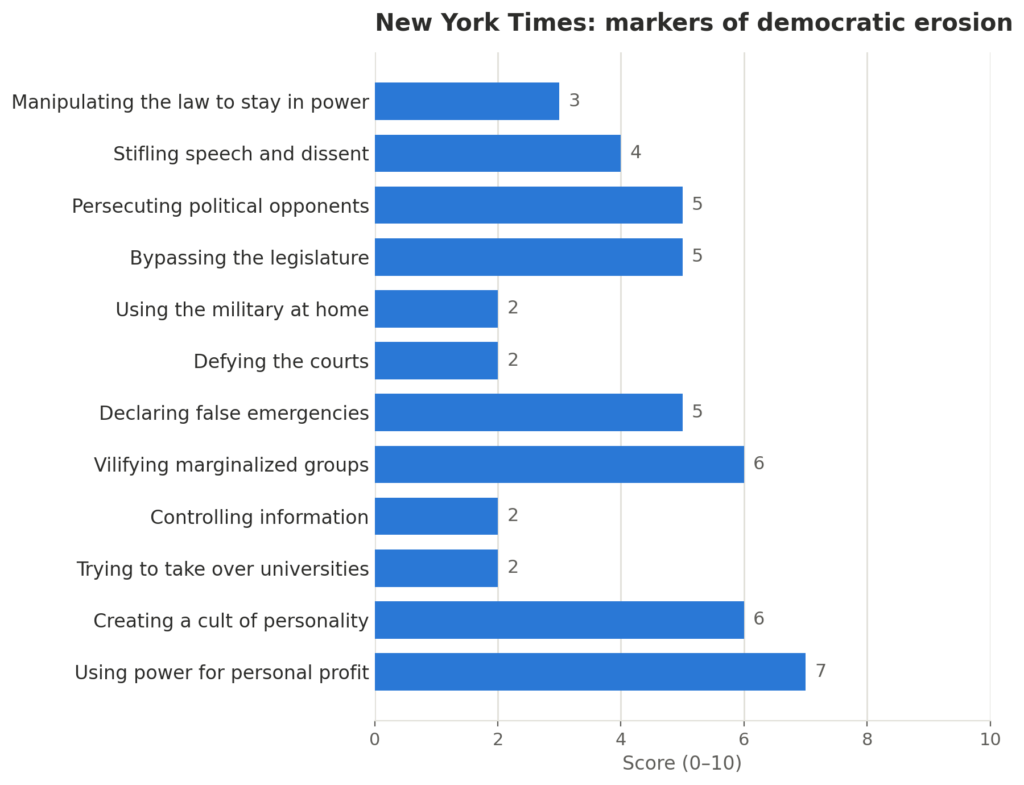
One of the Times’s 12 markers of democratic erosion is “Manipulating the law to stay in power.” On that indicator, the Times gives Trump a 3.
The accompanying text actually provides an excellent summary of Trump’s record on this issue. Here’s part of it:
Mr. Trump’s actions have left constitutional scholars and democracy experts anxious about this year’s midterm elections. They wonder if the Trump administration may use false pretenses to send federal agents to Democratic-leaning areas to intimidate people and suppress voting. Experts are also worried that after the elections, Mr. Trump may pressure legislators not to certify the winners, as he unsuccessfully tried to do after the 2020 presidential election. Even if he does not take these extreme steps, the gerrymandering campaign he has demanded has probably tilted the competition for control of the House of Representatives at least 2.5 percentage points in Republicans’ direction.
And that’s a 3? Seriously?
A 3 on a 10-point “pain scale” translates to “mild pain.” In forecasting, a 3 on a 10-point scale means “fairly unlikely”. Trump’s score for “Manipulating the law to stay in power” is not a 3.
Or consider the Times’s marker of “Persecuting political opponents.” This has been a hallmark of Trump’s second term!
His Justice Department is prosecuting his political antagonists for such things as a social media post of seashells. It indicted an innocent tourist to validate one of Trump’s conspiracy theories. His Department of Homeland Security ordered up a massive, wildly illegal surveillance op intended to make the case that peaceful anti-ICE protesters were organized antifa terrorists. (They were not.)
Maybe he’s not quite a 10. But how about an 8 or a 9?
The Times score is 5.
The highest score the Times gives is for “Using power for personal profit.” Trump of course has openly solicited bribes from companies doing business with the government and has corruptly steered multiple billions of dollars into his own pockets and those of his family. This puts him right up there in the pantheon of authoritarian looters. I’d give him a 10.
The Times has him at a 7.
The New York Times, as the country’s most exalted and influential news organization, should be sounding the alarm about autocracy on a daily basis — perhaps many times daily — on both its editorial and news sides. The voting public needs to fully understand the extreme danger Trump poses to what for so long seemed like immutable American values, such as the separation of powers, the right to vote, and free speech.
This is especially true with such a pivotal election on the horizon — one which holds the potential both for the overwhelming public rejection of Trump‘s authoritarian rule and the ultimate expression of it, if he sends the military to the polls, seizes ballot boxes in blue cities, or gets to tell the postal service whose ballots to deliver.
The Scale Is All Wrong
The kindest explanation for why the Times’s numbers are so understated is that its editors picked the wrong scale.
In their scale, “zero represents the United States before Mr. Trump began his second term — not perfect, surely, but still a strong democracy. Ten represents the condition in a true autocracy, such as China, Iran and Russia.”
But that’s a terrible scale. It’s almost guaranteed to understate the danger we face today.
First of all, zero should represent the country before Trump was president the first time — so 2015, not 2024. Yes, while Joe Biden was president our democracy wasn’t in danger, but it was still badly bruised from Trump’s first term — and evidently not healed.
If zero represented the state of democracy before Trump’s first term, then the individual scores when he began his second term should all have started prorated at something like a 2 — adding 2 points to each score right there.
The vastly bigger mistake, however, was having 10 signify the crushing absence of liberty in three countries that have been under totalitarian rule for most if not all of the last 100 years or more.
The United States, by contrast, has been a democracy at least in name for 250 years. We have a Constitution and — most importantly — a Bill of Rights. We have a thriving, independent civil society. Our elections are decentralized and, thus far, the results have never seriously been in question.
If you make Russia or China a 10 then the U.S. could never be a 10.
If the scale is to really mean anything, a score of 10 in democratic erosion ought to be something achievable for the U.S. I think a 10 should be the worst you can imagine the United States being.
A 10 in democratic erosion in the U.S. would, to me, indicate that the leader:
- Controls elections
- Controls the economy
- Controls much of the media
- Intimidates the media he doesn’t control
- Prosecutes his political opponents
- Treats dissenters like terrorists
- Uses a loyal, masked army to terrorize minorities and opposition territory
- Enriches himself with vast corruption
- Communicates almost entirely in lies and propaganda
- Ignores or controls Congress and the Supreme Court
- Asserts and enforces white Christian supremacist values
- Leads a personality cult
- Surrounds himself with sycophants
- Demands curricular changes and paybacks from universities.
When you think of it that way, a 10 is not so far away.
Is it?
A Closer Look at Their Numbers
The New York Times autocracy index launched in October of last year with the appropriately chilling question: “Are We Losing Our Democracy?”
We’re now up to the fourth iteration. Each time, one of the indicators has been bumped up a notch.
In February, under the headline “Trump’s Stifling of Dissent Reaches a New Level“, the editors moved “Stifling speech and dissent” up to a 4, citing the intimidation and force involved in the crackdown on anti-ICE protesters in Minnesota over the winter.
In May, citing Trump taking the country to war without any form of congressional authorization — “The Iran War Worsens America’s Democratic Erosion” — they moved “Bypassing the legislature” up to a 5.
And now in the latest edition, the editors pushed the slider up to a 3 for “Manipulating the law to stay in power” on account of Trump’s many efforts to rig the midterms.
These minimal changes are laughably insufficient given the extraordinary increases we’ve seen over the past 11 months in such things as the weaponization of law enforcement, the inhumane and heartbreaking treatment of detained immigrants, the erratic unilateralism of Trump’s tariff policies, his unhinged attacks on journalists, and the criminalization of dissent. And oh yes, his irrational, volatile, childish, unfeeling, and doomed prosecution of an idiotic war with Iran, launched on a whim and with no goal other than to exert power and brag about it. (There ought to be a category for “Abuse of the military to pursue personal goals,” and his score ought to be a 10.)
But here’s where the numbers stand, according to the editorial board:
And It’s Not Just Me
As I was gathering my thoughts about this, I realized I needed a second opinion. So I emailed Princeton sociology professor Kim L. Scheppele. She has spent much of her career watching democracies rise and fall — including a lot of time in Hungary — and she’s my go-to scholar on the march of autocracy.
“I think that the New York Times greatly underestimates the threat by using a scale that isn’t helpful,” she emailed me back. “I’m much more of an alarmist than the New York Times indicator.”
Her views on the proper scale are a bit different than mine. (Maybe a little more sophisticated.)
“The scale assumes that the relevant frame of comparison is ALL governments in the world at the moment. So the U.S. has the scores it has because, duh, we’re so much better than China. Or Myanmar,” she explained.
“But,” she wrote, “what if we wanted the answer to a different question — which is where we stand in the family of constitutional democracies, where we have always thought we belonged? In that comparison, we would be very close to the bottom.”
The Times is comparing apples and oranges. Scheppele prefers comparing apples and apples.
“In my work, I compare the U.S. (and Hungary and Venezuela) to their aspirational categories rather than with the whole world,” she wrote. “We may forget that Hungary and Venezuela were not so long ago the most stable and promising democracies in their regions before they became autocracies. That’s why those two countries are so much more instructive for us than two countries (say Russia and Egypt) that experienced autocratization beginning from a much lower starting point and so were never really comparable to the U.S.”
And what’s her conclusion about where we stand?
“The U.S is on an alarmingly fast autocratic track even though, for 250 years, it believed itself to be a democracy, however flawed,” she wrote.
“We are now entering the territory of being a ‘hybrid regime’ — where much is riding on whether the struggle to keep elections free and fair will succeed this fall. If the election is muddied or stolen by autocratic means, we will become an electoral autocracy. We’re that close.”
In Scheppele’s preferred scale, zero describes the top democracies in the world — mostly Nordic countries. And 10 is not a full-blown dictatorship, but electoral autocracy — a system that has elections with predetermined outcomes and some pretense of rule of law.
In my scale, as I described above, a 10 is an oppressive, personalist, hugely corrupt electoral autocracy.
And here’s how Scheppele and I would score it, as compared to the Times:
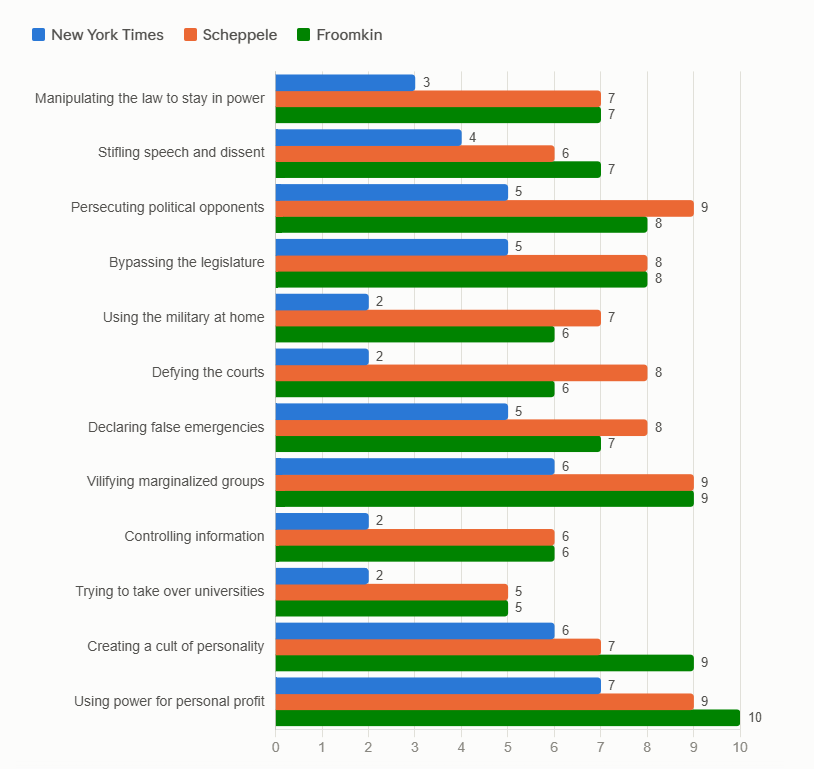
The average score? For the Times: 4. Scheppele and I score it slightly over 7.
At the Times, Sounding the Alarm Is Taboo
Even on their distorted scale, the New York Times editorial board’s scores are meek and understated. And I can tell you why.
It’s not an accident that these numbers aren’t alarming, it’s by design. The editorial board reports directly to the Times’s publisher, A.G. Sulzberger. The editorials represent his views.
And Sulzberger has created a tremendously stultifying corporate culture at the Times when it comes to writing about politics that explicitly prohibits journalists on both the news and editorial sides from expressing alarm.
At the Times, alarm is hysteria. It’s taking sides. It’s lowering one’s self to the level of partisans. It’s giving in to the critics — even if many of those critics are among the Times’s most loyal readers.
This is not conjecture. I wrote about it in March 2024 in a post headlined “Why is New York Times campaign coverage so bad? Because that’s what the publisher wants.” Sulzberger had just given a very revealing speech at Oxford University on “Journalistic Independence in a Time of Division” where he spoke of the whole concept of sounding the alarm with contempt.
“[W]hen I look at the forces keeping society from coming together to rise to the challenges of our era — whether in the Middle East, Ukraine, the United States or anywhere else — I see no lack of passionate, morally confident actors sounding the alarm. Indeed, the alarm seems so loud and so constant that much of the public has by now put in earplugs,” Sulzberger said.
There’s too much alarm, he said. He also made it very clear that he does not want his staff engaging in “an advocate’s crusading righteousness,” but rather in a “humbler mission: to seek the truth and help people understand the world.”
The Times does, in the rare news analysis, come close to sounding the alarm. For instance, back in April, it published a pretty stunning article questioning Trump’s mental fitness.
But they never mentioned it again. And the day-in-day-out coverage normalizes Trump’s mad-king behavior.
That’s because if you try to sound the alarm in Sulzberger’s newsroom — or even worse, on his editorial pages — you are taking a huge risk with your career. (That’s if a mid-level editor hasn’t already put a watered-down headline on your story, added a bunch of weasel words to your lead, stripped out essential context, and at best allowed the obvious conclusion to appear at arm’s length, attributed to “critics” or “Democrats”.)
The result is a sort of journalistic cognitive dissonance. Editorial board members, like their colleagues on the news side, accurately relate each new thing Trump does. Most of the time, they even characterize it in fairly harsh terms. And they’re not stupid. They know what’s going on.
But because of the culture of their newsroom, they must stop short of using the words or numbers that accurately describe the big picture — the one that is so very alarming.