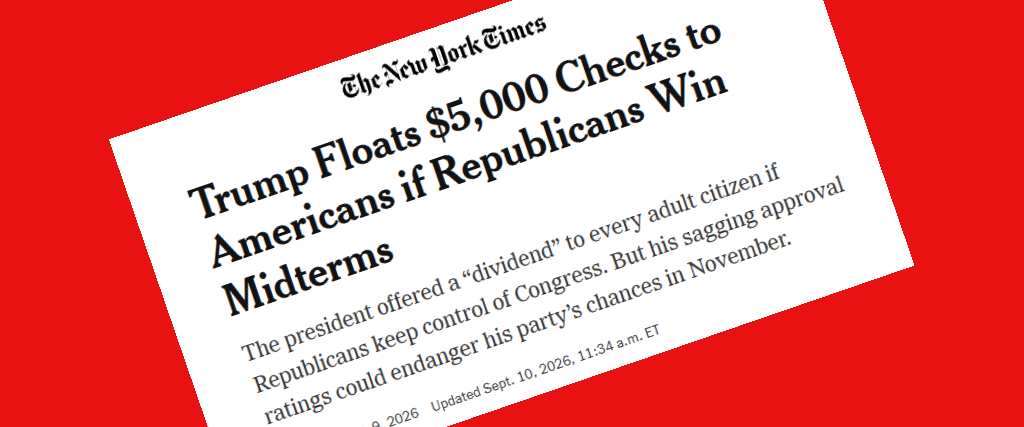

Donald Trump last night made a ridiculous promise that he won’t keep.
If Republicans maintain control of both the House and Senate, he said, he would give every adult in the U.S. $5,000.
The journalists covering his speech at the Republican “midterm convention” in Dallas had a choice to make: Should they be honest? Or should they allow themselves to be used?
Let’s see how they did.
And full credit requires accurately contextualizing it as an act of desperation.
(TL/DR: The headlines, which is all most people read, were mostly stenographic – a big win for Trump. As for the entire coverage, there were two standouts: AP and MS NOW. Everyone else pretty much whiffed, at best injecting a little skepticism about the logistics.)
But First, Some Quick Background
There’s zero chance of this happening.
It’s not just that Democrats are overwhelmingly favored to flip the House, if not the Senate as well.
It’s not just that it would cost upwards of $1.2 trillion – or about one sixth of the government’s annual budget.
It’s not just that it would nearly double the deficit, or cost more than the defense budget, or the non-defense discretionary budget.
It’s not that it’s illegal, which it may or may not be.
It’s that Trump is a liar and a con man with a lengthy track record of making promises he has no ability or even intention to keep. This is clearly one of them. He is a fabulist with less restraint every day.
Here’s exactly what he said:
Only I can make this promise to you, and here is my promise: If the Republicans win the House of Representatives and the United States Senate – both of them, because of our economic, tremendous economic success, like in, in history, we’ve never had anything like what’s happening, but because of our tremendous strength and success economically – I will issue a dividend to every adult citizen in the United States of America for $5,000. Very much like a successful company will do a cash distribution to its shareholders…
So if the Republicans win, you win with us and you get $5,000. It will be called the Trump dividend. We’ll call it the Trump dividend. Congratulations. Now all we have to do, now all we have to do is win.
How They Covered It
Every reporter within the sound of Trump’s voice knew immediately that it was bullshit.
If they were honest, they would have written that Trump offered a nonsensical and impossible kickback to voters in a desperate attempt to offset a blue wave that seems likely to crush Republicans in November, mostly because so many voters have turned against him personally.
Some got closer than others, but mostly they were not close. And they certainly put the dollar figure in a lot of headlines, which is what Trump was going for.
New York Times: C-
Tim Balk, Maggie Haberman, Annie Karni and Andrew Duehren – in an article headlined “Trump Floats $5,000 Checks to Americans if Republicans Win Midterms” – basically ended up carrying Trump’s water by offering almost no context. “The proposal to send money to Americans only if Mr. Trump’s party wins was an extraordinary one,” they wrote. “It was not clear how he would go about carrying out the measure, whose cost would likely exceed $1 trillion.”
Patricia Mazzei and Shane Goldmacher, in their “takeaways” from the speech, barely mentioned it, calling it “a potentially $1 trillion surprise: a questionable offer, light on details.”
That was it.
John Yoon took it seriously enough to game out how it might or might not work, writing that it “could have a significant impact on the U.S. economy.”
An article by Katie Rogers was given a promising headline – “Trump’s Dubious Midterm Pitch: Keep Us in Power and Everyone Gets Cash” – but her own words were weaker.
(Oh woops! It looks like some weak-kneed editor changed the headline to “Pleading for Votes, Trump Tries a New Spin on an Old Promise: Free Money.” That’s a goddamn shame.)
Rogers called it “a new idea,” noted it was “exorbitantly expensive” and wrote that “The president did not seem particularly concerned about the details of the plan.”
Rogers put the essential context at the bottom of her story, in the form of quotes from third parties. David Becker, the executive director of the Center for Election Innovation and Research, told her: “Whether it’s legal or not, it seems – just like with a lot of his election disinformation – it seems rather desperate… If I were a voter, I would be asking myself, why are you promising to do this in 2027? You control both houses now. Why not deliver on this promise now?”
Rogers also observed that “In several cases, the money Mr. Trump has promised in the past has not materialized.”
Indeed, many, many reports – including the Times’s Andrew Duehren’s – claimed that Trump had “promised” similar cash distributions to all Americans in the past. But that’s actually not true. Trump has teased several such ideas before, and talked about how he might propose them, but until now he never did.
So the one most common critique – also the easiest, and most “objective” sounding – turns out to be wrong.
The Wall Street Journal: B-
Philip Wegmann and John McCormick wrote that “Trump didn’t say if he would push Congress to pass such a measure, or why he isn’t pursuing such a payment before the election.”
Damian Paletta treated it like it was totally plausible, calling it “perhaps his biggest election-year promise to date” and asking “how could this be done in a way that didn’t cause a spike in inflation? That will largely fuel a huge debate.” (It won’t)
Alex Leary, Sabrina Rodriguez and Natalie Andrews redeemed their news organization somewhat by describing Trump’s promise as “a last-ditch bid to prevent an electoral shellacking.” But no details!
Washington Post: D
Isaac Arnsdorf and Natalie Allison’s article was headlined “Trump makes case for Iran war, promises $5,000 payouts if GOP wins midterms.” But the authors devoted all of one paragraph to the $5,000 part, with zero context: “He also debuted a new enticement, promising to reward Republican congressional majorities by giving every American a $5,000 dividend to spend within the country.”
That was it.
Aoife Walsh and Victoria Craw, ostensibly telling readers “What to know about Trump’s proposed $5,000 payouts,” wrote that there were “questions about how the benefit would work, whether it is legal and where the funds would come from.” They wrote that it “could require congressional approval.” Duh.
And they wrote that it “could face opposition over its potential effect on the national debt.”
Associated Press: A
Jill Colvin, Thomas Beaumont and Will Weissert – under the overly stenographic headline “Trump defends Iran war, slams Democrats and promises cash at Republicans’ midterm convention” – nevertheless nailed it:
The proposal, which could cost at least $1 trillion, was financially and politically implausible. But it reflected Trump’s apparent calculation that he needs bold moves to revive Republicans’ chances as Democrats try to take advantage of his low approval ratings in close races across the country.
A few hours later, the AP moved an article with a dead-on headline: “Trump, hoping to salvage midterms, makes a dubious pledge to give every US adult $5,000 if GOP wins”.
Jonathan J. Cooper called it “an extraordinary gambit to reverse his party’s sagging fortunes in November.” He added:
The dubious promise would most likely cost more than $1 trillion and require congressional approval, and would further exacerbate the country’s nearly $1.8 trillion annual budget deficit and concerns about inflation.
Reuters: C-
Nandita Bose, Steve Holland and Nathan Layne called it an “extraordinary overture” and wrote that “It was not immediately clear how the $5,000 payments would work or whether they would be legal. The proposal would likely cost more than $1 trillion, with approximately 270 million U.S. adults, and could require the approval of Congress.”
NPR: B-
Tamara Keith called it “a stunning and implausible pledge,” and wrote that “Quick math puts the bill for this proposed “dividend” at more than $1 trillion. Plus, it’s illegal to pay or be paid to influence voting.”
USA Today: D+
Joey Garrison and Zac Anderson called it “an extraordinary offer,” a “dramatic new twist” and a “brazen promise” that “could roil the midterms, injecting a controversial new wildcard with less than two months until Election Day.”
No pushback other than “he did not say how it would be paid for or how much it would cost.”
Politico: C
Ashley Ahn’s big takeaway was that it would “likely explode the deficit,” “worsen inflation,” and “exacerbate a rise in longer-term borrowing costs for the U.S. government.”
She also quoted “A GOP operative, granted anonymity to discuss the idea” who called it “a desperate attempt to change the political mood.”
Calen Razor called it “a hot mess of a half-baked midterm promise,” and wrote that “GOP fiscal hawks were balking at the effort before Trump even left the stage.”
Axios: C-
Ben Berkowitz noted that Trump has “made similar suggestions before, many times, none of which ever came to pass.” And under the “What we’re watching” rubric he made the ludicrous prediction that “If the GOP does pull off a sweep, expect to see Trump’s promise all over TV the next day.”
The Broadcast Networks: C
The promise was not a major topic on the morning shows, which is good. But they also totally missed the point.
On ABC’s Good Morning America, Mary Bruce briefly noted that “It’s unclear if the promise is legal, and Congress would have to authorize the payments. But the president did not say where and how he could come up where and how he could come up with the estimated 1.3 trillion it would take to pay every American adult.”
On NBC’s Today Show, Garrett Haake reported that Trump “has not said where that estimated $1.35 trillion would come from or how they could enforce where Americans spend the money. And the president has floated some similar payments in the past that have not come to fruition.”
On CBS’s CBS Mornings, Gayle King called it “a huge promise,” followed by Ed O’Keefe noting that it was “a move that critics say may not be entirely legal.”
CNN: B-
Anchor Sara Sidner sounded skeptical. “Promises, promises. President Trump promising to pay every American adult $5,000 if Republicans keep control of Congress in the midterms.
The question is whether this is legal. There are other questions as to whether he can keep his promise and what that is going to cost.”
Senior political analyst Ron Brownstein said that Trump’s “important” promise “needless to say, faces long odds of ever happening.”
On CNN’s website, Eric Bradner described it as “an extraordinary offer as he tries to keep his party in power,” and quoted Joe Brusuelas, chief economist at RSM US, saying: “It is the working definition of ill-timed and ill-advised fiscal policy.”
MS NOW: A
Stephanie Ruhle and her panel had a lot to say about it this morning.
“As soon as I heard about it, I texted every person I know close in the Trump universe or big Trump supporters, and I was ghosted by everyone,” Ruhle said.
MS NOW’s Vaughn Hillyard said the White House has been quiet: “We’ve reached out asking for details, what this would look like, how it’d be funded, yet none of that has been brought to the table despite it being what Donald Trump literally said in his keynote remarks last night was the biggest proposal of this midterm cycle.”
And he added this context: “It takes me back to 2024 campaign when right in the closing weeks of his presidential run, he promised Americans free access to IVF care. Just one round of IVF treatment is about $20 ,000. And it was not a serious proposal, one let alone that republicans would get on board with. But yet that’s the case that he made to the American public.”
Ruhle asked New York Times reporter Peter Baker: “Peter, how does this not reek of desperation, right?… You’re not coming from a position of strength if you’re throwing this Hail Mary pass with 50 days to go.”
“Well, it’s not the way other presidents would do it,” Baker said, cautiously. But then he got blunter.
“There’s no reason to think it’s serious,” he said. “He just sort of says these things and it doesn’t matter to him. It seems like if he doesn’t follow through as long as it’s out there in the mix.”
In Sinclair Lewis’ 1935 novel It Can’t Happen Here the neo fascist Republican candidate in the 1940 election wins by promising everybody $5000.