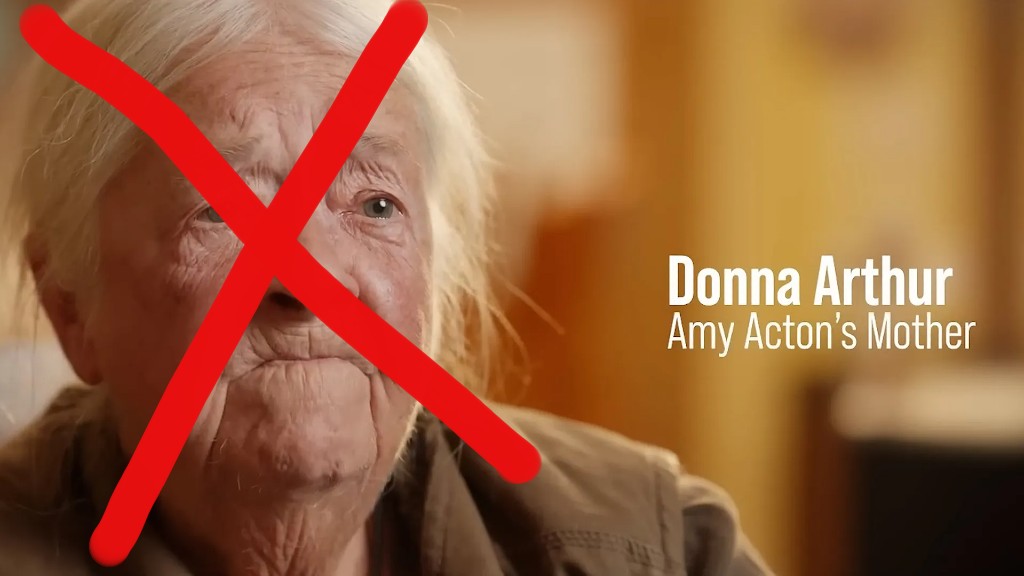

In his daily podcast on Tuesday, Chris Quinn, the top editor of the Cleveland Plain Dealer, the largest newspaper in Ohio, repeatedly used the word “vile” to describe Republican gubernatorial candidate Vivek Ramaswamy’s new television ad — the one revictimizing Democratic opponent Amy Acton by having her monstrous mother accuse her of lying about having been raped when she was 12.
“This is the worst of the worst,” Quinn said, “easily the most vile political ad we’ve ever seen, lowest, basest, most cruel move seen in an Ohio election.”
He continued: “As a human being, you don’t do this to another human being… I just cannot believe the monstrosity of what he’s done.”
This was an appropriate response to Ramaswamy’s soul-sickening ad, which cast Acton’s mother as an authority on her daughter. The mother who 48 years ago abandoned her daughter in favor of the man Acton and others said repeatedly raped her. The mother who has had no contact with Acton in 48 years. The mother who presumably enabled her abuse.
And yet journalists at Quinn’s own newspaper — just like their colleagues across the nation — failed miserably to adequately convey to their reading public the truly depraved nature of the ad, especially in the top of their news stories and the headlines.
They couldn’t bring themselves to use the right words, and in their failure unwittingly normalized the deeply, profoundly abnormal.
Several articles called it “a controversial attack ad” “featuring Amy Acton’s estranged mother” and one even described Ramaswamy’s decision to air it widely as “a risky doubling-down.”
Read the headlines from the Washington Post (“Ohio governor’s race in uproar over ad featuring Democrat’s estranged mother”), the Associated Press (“Vivek Ramaswamy defends ad with Amy Acton’s mother”), and the New York Times (“Attack Ad Featuring Candidate’s Mother Turns Ohio Governor’s Race Even Uglier”), and you see anodyne language that simply fails to telegraph the truly aberrant nature of the ad.
Headlines are tough. They’re so short! But the first paragraphs used pretty much the same language.
Presumably, all these journalists were using restrained language to avoid words that sounded like editorializing — like “vile”. But in this Trumpian age, where nothing is too low for Republicans anymore, it’s past time they toughened up.
Some news outlets use slightly stronger words, like “disturbing” (MS NOW and The Cut) or “explosive” (Reuters). Some, like the Guardian, put the necessary adjectives in quotes (“deeply troubling”).
Maybe the answer is longer headlines. Props to People, which went with: “Amy Acton’s Stepfather Was Charged with Raping Her When She Was a Child. Now Her Ohio Election Opponent Is Using That Against Her.”
There were some valuable sidebars, like this one from the Plain Dealer: “As Acton’s childhood becomes political fodder, experts warn rape survivors may stay silent”.)
One sidebar that missed the target was this one, in the Washington Post: “Ramaswamy’s Ohio attack ad shows ‘owning the libs’ may have limits.” I liked the thesis, which was that maybe only Trump can get away with being utterly depraved, because of his cult of personality. But the lame language and jokey headline undermined the argument.
I think at the very least the headline writers should have used words like “objectionable” or “appalling”. And yes, more words, period. Like “Ramaswamy ad revictimizes Acton, who was raped as a child,” or “Ramaswamy ad stars Acton’s failed mother claiming Acton lied about childhood rape”, or “Acton’s abuse-enabling mother stars in Ramaswamy ad.”
The television news coverage has been much better, probably because no even slightly empathetic person can talk in a normal tone of voice about this stuff.
So on CNN, Jake Tapper said: “You need to understand what she is accusing her daughter of lying about. Court documents show that that woman’s husband, Acton’s stepfather, was arrested when Amy Acton was only 12 years old for raping Amy Acton. And that woman on that ad lost custody of her daughter and son, and she sided with the husband accused of rape.”
Tapper called the ad “so gross… that it could even hurt other Republicans on the ballot in Ohio.”
After showing Trump saying of Acton, “I say that she’s fair game,” Tapper said, “I mean, what was fair game? Was Amy Acton, when she was a child, was fair game for that woman’s husband who was raping her, allegedly? That’s the fair game we’re talking about. And President Trump sticking with the woman who stuck by the accused child rapist.”
On MS NOW, Nicolle Wallace started off her report by saying the ad “would suggest that the bottom isn’t there…. That it’s truly bottomless in the MAGA Republican Party.”
And she interviewed Quinn, the editor I quoted at the top.
“I have 450 text messages from people today, almost unanimous in condemnation of this ad,” Quinn said. “We’re hearing from people who are saying ‘I was on the fence. I’m not on the fence anymore.’ People want empathy in a candidate and what he did is revictimize the victim.”
Quinn continued: “This has just disgusted people in Ohio. I’m not hearing from anybody saying ‘Oh I support him.’ I know there are some things on social media that do that, but for our readers, the people who pay attention to the news, not.”
(Read my 2024 post about Quinn: “An interview with a newsroom leader who speaks the truth about Donald Trump.” “The north star here is truth,” he told me. “We tell the truth, even when it offends some of the people who pay us for information.”)
Even on ABC, Jon Karl on World News Tonight noted that “Acton was removed from her mother’s custody when she was just 12 years old after her stepfather was charged with raping her. They haven’t spoken since, but now Acton’s opponent, Vivek Ramaswamy, has put her mother in a campaign ad.”
Trump was in Iowa last night campaigning for Republican Senate candidate Ashley Hinson, who wanted nothing to do with the ad. “I think about it as a mom,” she told reporters, “and you think about your kids surviving childhood sexual abuse and having to relive that trauma on tv again. I think it’s absolutely terrible.”
Opinion writers of course have much more leeway. The most brutally effective headline I saw on an opinion piece was at the Columbus Dispatch: “Ramaswamy ran numbers on a 12-year-old girl’s rape and liked what he saw.” (Although that apparently was some sort of “alternative” headline, so you can only see it on this page?) The guest columnist, Ray Watford, was referring to an Axios story which said the ad “tested well” with “persuadable” voters.
Two other Dispatch columnists were pretty upset, too. Mike Curtin wrote that “Ohioans never have witnessed a more depraved, amoral political attack than the one just launched by Vivek Ramaswamy against Dr. Amy Acton.” Ray Marcano wrote: “The damn[sic] has broken and Vivek Ramaswamy is drowning in his own slime.”
The Dispatch did find one person who liked the ad. Republican State Rep. Beth Lear complained that “Democrats and the media” were engaged in “a masterful attempt to manipulate voters’ emotions by making Amy a victim.”
She gave the media too much credit.