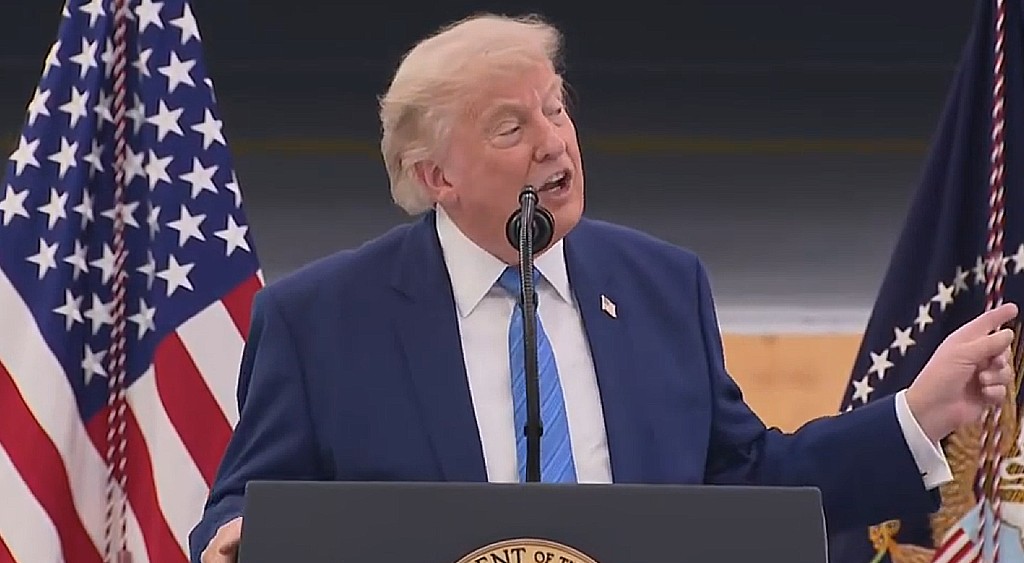

It’s been wild lately watching mainstream news coverage swing from “Trump cancels US strikes in Iran and suggests agreement is close” to “Deal is reached to end Iran war” to “There are many questions about the Iran deal” to “Why Trump’s secret and vague MOU is stirring a political storm” to “First steps in peace deal demand far more from U.S. than Iran” to “US-Iran talks abruptly called off after Israel and Hezbollah trade deadly attacks”.
What is gradually becoming clear, even to a credulous press corps, is that the U.S., having effectively surrendered to Iran, emerges much weaker. Iran’s tyrannical leaders, having gained significant economic concessions, emerge much stronger.
That’s the essential takeaway: That Trump unilaterally went to war against Iran, then lost, at great cost to his country and the world.
But the coverage still reflects a lot of false assumptions about Trump and his motives.
Most significantly, it assumes that Trump had intelligible policy goals to begin with: That he wanted regime change, to free the Iranian people from oppression; that he wanted to eliminate Iran’s ability to threaten its neighbors; that he wanted to end the Iranian nuclear threat that he vastly exaggerated.
And now, according to the media narrative, he has grudgingly sacrificed those goals in the name of avoiding worldwide economic disaster.
This is completely wrong.
Despite the mainstream media’s insistence on sanewashing Trump – by writing about his “unfiltered, improvisational style” or describing him as “a self-indulgent political leader who trusts his own instincts” – he is, in fact, not sane.
Call it what you will – narcissism, solipsism, sociopathy, hedonism, paranoia, dementia – the evidence overwhelmingly shows that Trump cares about only one thing: Trump.
Nothing else.
His only motivation – regardless of the reasons he or his lickspittles cite – is self-aggrandizement. His only goal is to make himself feel powerful.
Think about this for a second: Do you really think Trump went to war in Iran because he cares about Iran? Or the Middle East? Of course not.
If he ever actually cared about Iran getting a nuclear weapon, he wouldn’t have terminated Obama’s 2015 agreement. But he cared more about spiting Obama, which made him happy.
No, Trump went to war because he wanted another easy victory like the one in Venezuela, which took two hours and 28 minutes. That one made him feel really good.
He went to war because Israeli Prime Minister Benjamin Netanyahu convinced him that it would cement his role in history.
He went to war because he wanted to feel powerful and look masterful — to one-up his predecessors. For bragging rights.
He didn’t have a strategy to meet any of his supposed goals if the initial rounds of bombing failed to achieve them. That’s because he wasn’t really thinking about the Iranians, or Iran’s neighbors, or the Strait of Hormuz. He was only thinking about dropping bombs, killing people, then celebrating victory.
Once it became clear that the Iranian regime wasn’t giving up anything – and in fact was counter-attacking, asymmetrically but to great effect – he fell back on two tactics that have served him so well over the years: Denying reality and bullying. He alternated between declaring that he had already won and threatening apocalyptic destruction.
But reality didn’t change. And the threats didn’t work — in part because he constantly withdrew them.
Interestingly, during this period, he did let slip just how little he cares about the American people.
In May, asked whether Americans’ economic troubles might motivate him to make a deal to end the war, he said “not even a little bit… I don’t think about Americans’ financial situation.”
Then came his “I love the inflation” quote on June 10, after a major spike in prices.
And now we’re supposed to believe he suddenly cares about the economy?
So why did he finally agree to surrender? I think he was persuaded by members of his party that continuing the war would make it even less likely that he could have his way with Congress after the midterm elections. But more than that, I think he realized that the war was making him look weak, not strong.
Trump said on Wednesday that his motive was that “I didn’t want to see economic catastrophe,” but I think the real reason was more personal, relating to his place in history. As he also said on Wednesday: “The one president I did not want to be was the late, great Herbert Hoover.”
And keep in mind, he didn’t really care about Iran in the first place.
Doing an about-face on regime change is easy if you don’t really care about freeing Iranians from their repressive government. Trump on Wednesday described the current leaders — who if anything are more hardline than the previous ones — as “far less radicalized. And I think they’re — I think they’re really good.” He continued: “frankly, I think that’s regime change.”
Doing an about face on Iran having ballistic missiles is easy if you don’t really care about them threatening their neighbors. On March 2, Trump said: “Our objectives are clear. First, we’re destroying Iran’s missile capabilities.” Now, he says “if other countries have them, it’s a little bit unfair for them not to have some.”
The CBS Evening News, of all places, did a pretty nifty montage contrasting Trump’s statements then and now.
And keep in mind that he hasn’t stopped saying absolutely crazy things about Iran.
He continues to threaten Iran with obliteration, even though he signed a memo of understanding in which he promises “the immediate and permanent termination of military operations on all fronts” and “to refrain from the threat or use of force.” On Wednesday, he said “if they don’t behave, we’ll go right back to dropping bombs right smack in the middle of their head, OK?”
Trump also called New York Times reporter David Sanger on Sunday afternoon, and told him that if Iran drags out negotiations, one possibility is that the U.S. would come in and patrol the entire area – become “the guardian of the Middle East” — in return for 20 percent of the region’s revenues. That’s nuts.
And now, in an interview with Axios, he is claiming victory – saying that the MOU “probably is unconditional surrender” and that there are “no limits” to his power. He’s threatening Cuba next.
He’s maniacal. He’s delusional. He’s unstable. And he has no principles.
Yes, it’s good that the media is finally getting wise to the fact that Trump failed miserably in Iran.
But as long as White House journalists act as if Trump is making decisions like a normal person – as long as they quote him without disclaimers, and put whatever he says in the headlines, and use adjectives like “unfiltered” to describe what is in fact lunacy — they’ll keep deceiving the public.