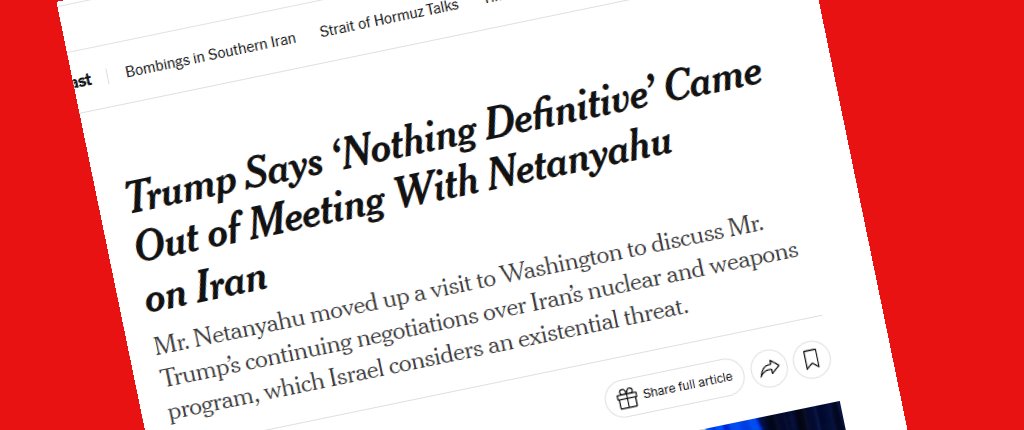

(Scroll down for 18 New York Times “Trump says” headlines in a recent 3-month period that spread misinformation.)
Donald Trump says so many things that aren’t true that the legacy media’s compulsion to put what he says in a headline is a major vector for misinformation.
It’s not just that Trump straight-up lies — which he does frequently. There are many other reasons not to believe what he says at any given moment, including that:
- He changes his mind repeatedly
- He has no idea what he’s talking about
- He is delusional
- He is wildly exaggerating
- He says whatever pops into his head
- He changes his story depending on the audience
- He has been misinformed by his quislings telling him what he wants to hear
- He has been manipulated by zealots
So I’m calling for a moratorium on the ubiquitous “Trump says” headline.
It’s simple: Newsroom leaders should ban headlines based on what Trump says if there is legitimate reason to suspect that he may not be relating truthful, accurate, and durable information.
I’m only a tiny bit more tolerant of the Trump “claims”, “maintains”, “blames”, and “insists” headlines, but at least those impart an iota of doubt.
Consider, for instance, how on July 30, Trump wrote on his social media site that his so-called “Board of Peace” had “reached a HISTORIC agreement for the COMPLETE DISARMAMENT of Hamas” and the withdrawal of Israeli forces. It could not have been more obvious to any rational observer that this was a delusion and that neither side had agreed (or would agree) to any such thing.
And yet the New York Times headlined its article “Trump Says Peace Board Has Plan for Gaza Disarmament.” (The original headline was also horribly naive: “Trump Claims Deal Is Reached to Disarm Hamas in Gaza”.)
And consider what happened just this morning, even as it has become blindingly obvious that Trump is desperate to get out of the war and that Iran is holding all the cards. Trump claimed on his social media site that Iran’s demands for reparations were “never mentioned” in previous negotiations – a spectacular lie – and announced that he would henceforth demand reparations from Iran. That’s absurd, deceptive, and delusional. Nevertheless, Reuters headlined its article “Trump says Iran must pay compensation for those it has killed and wounded.”
Indeed, there is a special place in hell for the credulous coverage and deceptive headlines relating Trump’s statements about Iran.
There have been innumerable headlines about Trump’s claims of progress in talks when there wasn’t any. I wrote in late May about how the entire Memorial Day weekend was consumed with headlines about Trump’s imminent “peace deal.” Instead, more than three weeks later, Trump signed a “memo of understanding” that predictably resolved nothing. (And after that memo became public, the headlines failed to explain that Trump effectively surrendered.)
Perhaps more than anything, Trump’s nearly constant threats of war-crime level destruction, from which he always backs down, have been rewarded with stenographic headlines.
News organizations know better. In their more thoughtful analyses, they acknowledge that he repeatedly says he’ll launch devastating strikes on Iran and then doesn’t. (He also frequently announces he’s halting strikes in Iran, but they keep happening.) Nevertheless, the credulous daily headlines continue apace.
It seems like no matter how spectacularly unrealistic a Trump statement is, he gets the headlines he wanted. “US to take over Strait of Hormuz, charge 20 percent fee for cargo shipped through, Trump says,” Politico headlined on July 13, even though Trump predictably backtracked hours later.
Surely our top newsroom leaders don’t see themselves as being in the business of spreading disinformation. But that’s what happens when they use the headlines and the tops of their articles to tell us what “Trump says” without caveats or pushback — when their headlines and leads should instead be devoted primarily to those caveats and pushbacks.
The New York Times Proves My Point
As a test case of my theory that these “Trump says” headlines are regularly vectors for misinformation, I looked back at New York Times articles using that exact construction from January 1 to March 31 of this year -– recently, but also with enough time having passed to objectively assess whether they provided a service, or a disservice, to readers.
Here are 18 headlines I found:
- Trump Says U.S. Is ‘Locked and Loaded’ if Iran Kills Protesters, January 2; page A1
- ‘I Don’t Think We Like Them’: Trump Says MAGA Has No Room for Antisemites, January 12; page A12
- Trump Says Civil Rights Led to White People Being ‘Very Badly Treated’, January 13; page A14
- Trump Says He Will Impose a 25% Tariff on Countries Trading With Iran, January 14; page A9
- Trump Says He Has Framework for Greenland Deal as NATO Mulls Idea of U.S. Sovereignty Over Bases, January 21; page A1
- Trump Says He Bruised His Hand on a Table, January 23
- Trump Says He Only Appeared to Nod Off in Last Cabinet Meeting Because It Was ‘Boring’, January 29
- Trump Says Kennedy Center Will Close for 2-Year Reconstruction Project, February 2; page A1
- Trump Says ‘Nothing Definitive’ Came Out of Meeting With Netanyahu on Iran, February 11; page A10
- Denying Racism Claims, Trump Says Some of His Best Friends Are Black, February 24; page A14 (print edition headline.)
- Trump Says War Could Last Weeks and Offers Contradictory Visions of New Regime, March 1
- Trump Says U.S. Navy Might Escort Tankers in Persian Gulf, March 3
- Trump Says U.S. Has Ample Weapons for War With Iran, March 8; page A14 (print edition headline)
- Trump Says Surrender Must Be Unconditional For Any Deal With Iran, March 17, page A1
- Trump Says U.S. Is Negotiating End to War, but Iranians Push Back, March 23, page A1
- ‘We Saved’ Middle East, Trump Says, March 29, page A1 (print edition headline)
- Trump Says Iran Agreed to Allow 20 More Ships of Oil Through Strait of Hormuz, March 29
- Trump Says U.S. Will Be Out of Iran Within Two to Three Weeks, March 31
Lies, misconceptions, deceptions, diversions, or delusions – all delivered as if Trump could be taken at his word.
I’d like to ask the senior editors at the New York Times: Do you think these headlines were good journalism? Did they serve your readers? Do you regret these headlines in retrospect? Is there a lesson here? How about not doing that anymore?
A Better Way
Most news organizations at one time or another have tried to telegraph to their readers that a particular Trump statement was not to be taken at face value.
I liked this Associated Press headline, “Trump says a former president had an Iran confession. Aides to his predecessors deny recent contact,” back in March.
The Times, which did a better job than most in telegraphing skepticism about Trump’s Reflecting Pool vandalism claim, ran this headline early on: “Trump Blames Vandals for Reflecting Pool Problems. Internal Records Tell Another Story.”
But most of the time, if there’s any pushback at all in headlines about Trump whoppers, it consists of weak language instead of explicit warnings -– like this AP headline: “Trump tries to blame Reflecting Pool woes on vandalism, without offering substantiation.”
Many media critics have long advocated for news organizations to employ the “truth sandwich” to surround Trump’s lies with clear statements about reality. That could even work in headlines, at least to some extent:
- “‘We Saved’ Middle East, Trump Says” could be “Trump Disrupted Middle East, He Didn’t ‘Save’ it”
Context and skepticism would be a good alternative to stenography:
- “Trump Says He Has Framework for Greenland Deal as NATO Mulls Idea of U.S. Sovereignty Over Bases” could be “Trump’s Obsession With Greenland Leads to Wild Claim”
- “Trump Says Civil Rights Led to White People Being ‘Very Badly Treated’” could be “Trump Adopts White Nationalist Rhetoric on Civil Rights Movement”.
His history of untruths makes expressing doubt entirely reasonable:
- “Trump Says U.S. Will Be Out of Iran Within Two to Three Weeks” could be “Trump Makes Another Doubtful Claim About Leaving Iran”.
Sometimes it’s as simple as headlining the obvious truth:
- “Speaking for Fallen Soldiers, Trump Says They Supported the Iran War” could be (and was, in Mother Jones) “Trump Puts Words in the Mouths of Dead Soldiers”.
I argued last week that news organizations need to stop the sanewashing and directly address Trump’s departures from reality. And while that’s a tougher ask for news organizations terrified of appearing to “take sides”, there’s got to be a way:
- “Trump says Iran must pay compensation for those it has killed and wounded” could be “Trump rejects reality of his weak position in Iran, makes outlandish new demand”.
Taking a cue from the Daily Beast, some headlines could start “Trump, 80,”.
A reasonable headline right now would be “Trump Sticks to the Delusion that Vandals Caused Reflecting Pool Damage”.
But please, no more credulous stenography in headlines. It’s “fake news.”
—————-
I’ve argued before that every time Trump is quoted, journalists should make it clear, high up in their reports, that he is untrustworthy.
I’ve advocated for disclaimers like “Trump’s previous statements about the war, including why he started it, have been erratic and contradictory.”
I wrote a precursor to this column in June, headlined “Stop putting whatever Trump says about Iran in the headlines”.