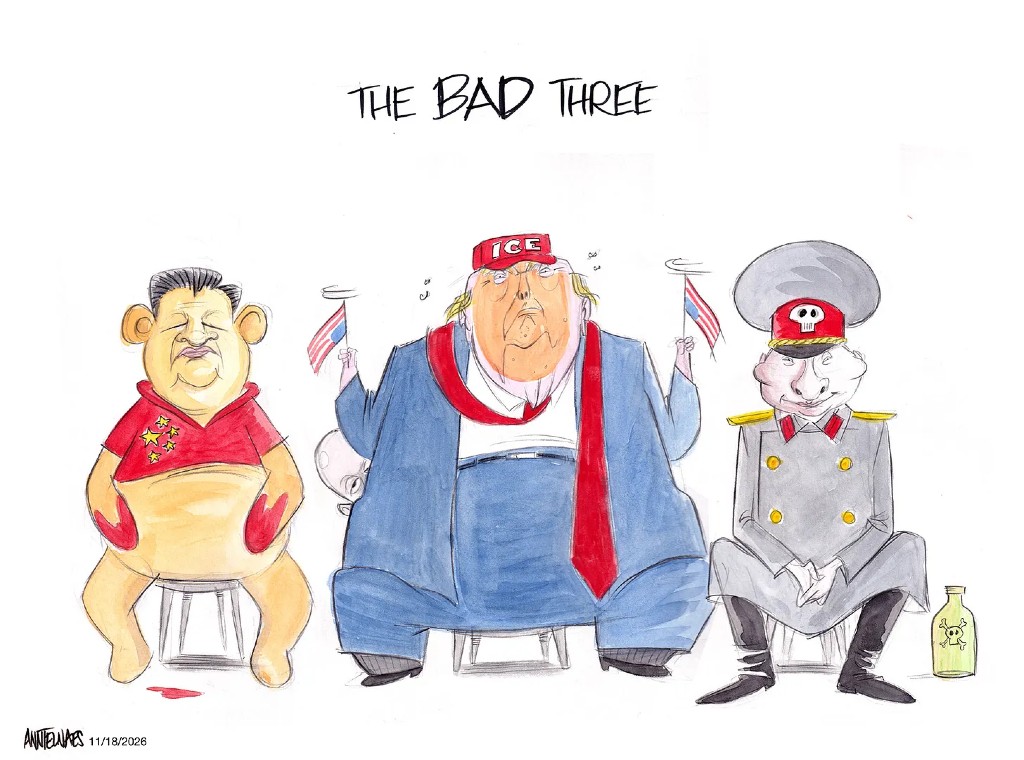

Donald Trump’s main reason for participating in a three-way summit with Chinese leader Xi Jinping and Russian President Vladimir Putin is the photo op.
Trump is eager to be seen standing side by side with these two other strongmen, arguably the two people he admires most in the world. These are pictures he will put up on his bedroom wall someday.
The media outlets calling this a “high stakes summit” are hopelessly stupid. The idea that Trump could negotiate any sort of a serious agreement with anyone is risible – he is a bloviating waffling nincompoop who is incapable of anything like a substantive discussion, not to mention the skillful manipulation of two of the wiliest cats on the planet.
Trump will tell them all about his construction projects. They will go home and laugh at him. He’ll have something he can frame.
That’s the best-case scenario.
The worst-case scenario is that Xi and Putin will take advantage of Trump’s political and mental weakness – and his extraordinary susceptibility to flattery – to get him to give up something important. Like Taiwan. Or Ukraine. Or Europe.
This is no joke.
Emerging from an EU summit in Dublin, German Chancellor Friedrich Merz on Friday said he and his fellow leaders are fearful. “I therefore want to state our message to the United States very clearly: please, no surprises. Continue to play as part of ‘Team Europe’ and ‘Team Ukraine’.”
Coverage of the summit in the US media has ranged from wide-eyed to appropriately terrified.
On the starstruck side, Politico described it as “an extraordinary round of diplomacy.” CBS called it “highly anticipated.” All three members of a Fox News panel agreed that “President Trump is going to be the big winner”.
The official White House line on Friday – dutifully reported – was that Trump would “discuss the reduction of nuclear weapons in the world” and would steer away from discussing Ukraine or Iran.
But on Monday morning, Trump told reporters “We’ll talk about, my favorite subject, Ukraine. Ukraine’s losing Ukraine,” and he confirmed that he would press Xi and Putin on the Iran war “to get involved, to get it ended.”
It was a reminder that there’s simply no telling what will come out of that man’s mouth.
(Case in point: He also spewed racist garbage, telling Black journalist Yamiche Alcindor, who had asked a tough question about his obsession with vanity projects, that “You never notice broken windows obviously from where you come.” As usual, no one in the press corps confronted Trump about it.)
Some American journalism on the summit has focused on the lack of substance. On PBS News Hour, NPR’s Tamara Keith noted that Trump “will get the image that he wants, which will be Trump and Xi and Putin all together, these three global powers.” She continued: “In some ways, that’s all he wants. Often the president doesn’t come into these meetings with a very clear agenda.”
Cleve R. Wootson Jr. and Joshua Yang called it a “high-stakes gathering” in the Washington Post – but then acknowledged that the stakes were actually low. I mention this typically meh story from the Post mostly because the AI-generated summary of reader comments was typically delicious and insightful:
The comments express significant concern and skepticism about Donald Trump’s upcoming trilateral meeting with Vladimir Putin and Xi Jinping. Many commenters fear that Trump will be manipulated by the two leaders, potentially compromising U.S. interests for personal gain.
Only a few US newsrooms warned of a possible cut-rate Yalta moment.
Yalta was where Franklin Delano Roosevelt and Winston Churchill agreed with Joseph Stalin that the Soviet Union would henceforth dominate Europe’s eastern half.
Bloomberg went there, starting off its report:
At Yalta in 1945, the leaders of three dominant military powers gathered to craft a plan that would bring stability to the world – or conspired to carve it up among themselves.
Both readings of that famous World War II meeting are still alive and well, eight decades later.
Here and now, Bloomberg explained, “Putin increasingly presents the war in Ukraine as part of a much larger reshaping of the world order.” The author noted concerns in Japan, South Korea, and Taiwan that their fates could be determined without them being in the room.
And Axios’s Barak Ravid wrote that the summit “has the makings of an unpredictable spectacle – and that’s exactly what has U.S. allies anxious.”
Ravid wrote that “the fear is that [Trump] could go off script and take positions on Ukraine or Taiwan that undermine their interests or appear to side with their chief adversaries, according to several European officials and Western diplomats.”
But the view seemed clearer from abroad.
Patrick Wintour wrote in the Guardian that “Putin has long proposed this re-enactment of the greatest wartime summit,” and that “Many excluded from the summit in Shenzhen, principally Ukraine but also eastern Europe and Baltic countries, Taiwan and even Iran, have reason to be nervous that their sponsors might abandon them in a complex geopolitical trade-off that Putin envisions, and Trump seems to endorse.”
Writing for Agence France-Presse, Sam Davies reported that the summit “has prompted alarm of a modern-day Yalta Conference, with three powerful men carving up the world — with little regard for Ukraine, Europe and Taiwan or anyone else.”
A Le Monde editorial amplified worries “about the world being ruled for years to come by three predatory empires whose insatiable appetites consume the planet.”
In an excellent New York Times opinion piece, former diplomat Kurt Campbell wrote about “the message conveyed by two strongmen and a would-be third standing together astride the planet, surveying the scene.”
His conclusion:
This will unnerve America’s traditional allies — clearly a plus for Mr. Putin and Mr. Xi, and probably irrelevant to Mr. Trump. Even if the discussions focus only on the stonework in Mr. Trump’s new ballroom, the flight time from Moscow to Shenzhen or the quality of the local Cantonese cuisine, projecting the image of these three leaders meeting together may well be the real purpose at work in Moscow and Beijing.
By contrast, the big New York Times summit preview from the news side by David E. Sanger and Peter Baker didn’t even raise the possibility that Trump might do something really stupid, or craven, or heinous. It treated Trump like a normal geopolitical player, which is crazy.
Putin’s strange hold on Trump is another huge factor getting short shrift in the American media (with one kinda shocking exception).
Consider how we still don’t even know what Putin and Trump talked about for two hours, with no one but interpreters present, during their summit in Helsinki way back in 2018. All we know is that Trump emerged trusting Putin more than his own intelligence agencies.
Before becoming president, Trump’s luxury real estate business was fueled by money laundering for Russian oligarchs. It’s never been clear why special counsel Robert Mueller never completed the counterintelligence investigation into Trump’s Russian ties. Mueller’s report “identified numerous links between the Russian government and the Trump Campaign” and explicitly did not exonerate Trump.
Since then, Trump has had a cozy, even deferential relationship with Putin, increasingly taking Putin’s side in the war against Ukraine and culminating in his extraordinary decision last month to waive some of the punishing sanctions imposed on Russia, ostensibly to increase the world diesel supply.
The three-way summit in China was Putin’s idea, and Trump has invited Putin to the G20 summit in December, which is being held at Trump’s Doral Miami club.
Oddly enough, the Wall Street Journal’s radically right-wing editorial board is nearly unique in American media in saying what to some people has become obvious.
The Journal, responding in particular to the bizarre circumstances around the diesel deal, concluded that “It’s increasingly hard to resist the conclusion that Mr. Trump’s real goal is to appease Mr. Putin.”