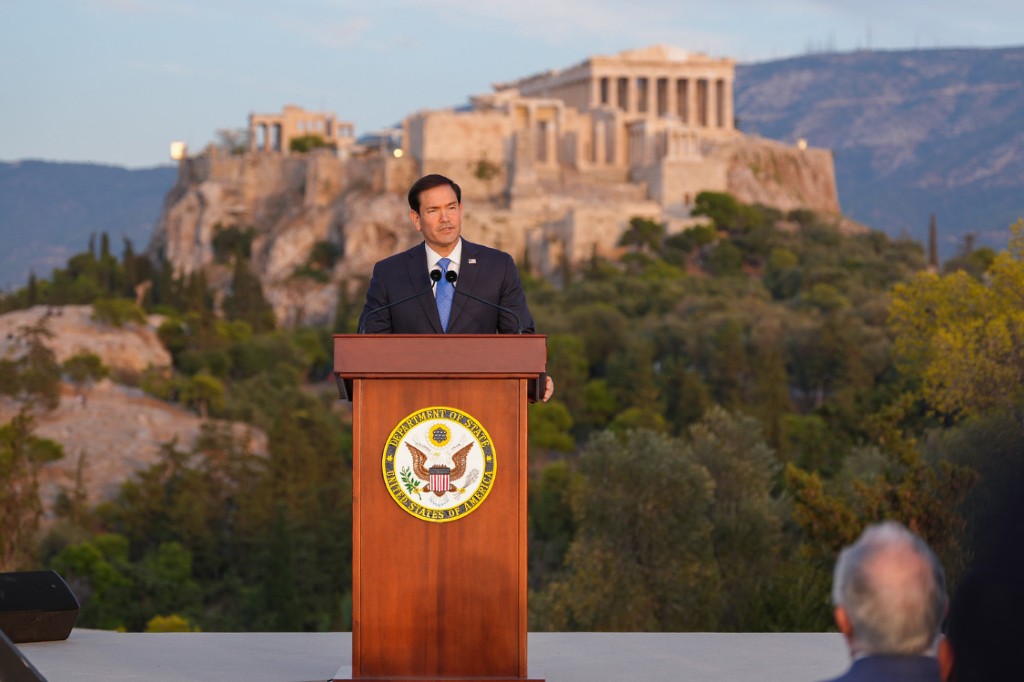

Secretary of State Marco Rubio gave an overwrought, made-for-TV, ethnonationalist speech on Wednesday in Athens, declaring Western civilization superior to all others, celebrating its history of dominance and empire, and extolling Trump’s “unapologetic pursuit of national power” — even as the U.S. is losing a war to a non-Western country whose economy is about the size of Tennessee’s, and not long after Trump tried to wrestle Greenland from Denmark.
My point being that his comments required context and critique.
But some of the coverage – particularly in the New York Times – could just as well have come out of the State Department’s PR shop.
Edward Wong, writing in the Times, served as dutiful stenographer, his article almost entirely made up of quotes and paraphrases — his tone deferential, if not admiring.
He quoted Rubio saying “Today, we find ourselves at a crossroads,” and asserting that “The course we take will determine whether the West maintains its place at the head of the world, or resigns itself to a future of atrophy, servitude and decline. We’ll either choose to act now, or lose the choice to act at all.”
There was no pushback. No mention whatsoever of alternate views, certainly no criticism. This is what Wong had to say in his own voice:
Mr. Rubio’s speech sought to highlight the ideological tenets of an American conservative movement whose adherents see President Trump as their leader.
Pretty lame. Other news outlets did a lot of stenography as well, but at least weren’t quite so empty-headed.
Writing for the Associated Press, Matthew Lee, Derek Gatopoulos and Farnoush Amiri leavened their Rubio quotes by pointing out one obvious criticism: They noted that some Europeans consider Trump’s “staunch anti-immigration stance” to be racist. And, they wrote:
Rubio also hailed the Spanish conquistador Hernán Cortés as an heir to the Athenian concept of exploring and pursuing knowledge for knowledge’s sake. Cortes is viewed much differently in Latin America, where his toppling of the Aztec empire and other bloody conquests are remembered for huge numbers of dead and the theft of treasure.
In the Wall Street Journal, Vera Bergengruen and Robbie Gramer addressed the geopolitical reality:
The lofty speech may do little to resolve persistent doubts about whether Europe can depend on the U.S. as a long-term ally. European leaders are rattled by Trump’s trade war with allies, his reluctant support for Ukraine, and efforts by the administration to possibly dramatically reduce the U.S. military footprint across the Continent.
The war in Iran has added another significant strain, leaving Europe and U.S. allies in Asia squeezed between a U.S. president angry that allies haven’t stepped up to support his military campaign and the prospect of being drawn into another lengthy Middle East conflict.
John Hudson, writing in the Washington Post, focused on the politics:
Secretary of State Marco Rubio arrived in Greece as America’s top diplomat, but he delivered a speech befitting a politician trying to inherit the MAGA movement.
And the optics:
The address was a major production, with staffers operating four State Department video cameras, including one mounted on a crane for cinematic shots of the secretary on the Pnyx, the hillside where ancient Athenians gathered to debate and vote, laying the early foundations of democracy.
CBS News’s Olivia Gazis cast Rubio’s as maybe a bit out of touch with reality:
As the United States wages a costly war with Iran and Europe struggles with the grinding conflict in Ukraine, Secretary of State Marco Rubio stood before the Acropolis on Wednesday and reached back more than two millennia to argue that the answer to the West’s current problems can be found, at least in part, in ancient Greece.
And later she noted that:
The history Rubio presented was arguably selective. He spoke relatively little about democracy or political equality at a site closely associated with both, focusing instead on competition, national loyalty and the willingness to take risks.
In a CNN analysis, Stephen Collinson provided some of the necessary context so many others did not:
One interpretation is that this was yet another bid to retroactively impose doctrinal coherence on Trump’s erratic foreign policy of Iran war-style gut calls, power grabs and a transactional approach to resources.
Collinson wrote that Rubio “might also have been trying to make sense of his own political evolution from aspirational conservatism to his current, darker worldview. (Rubio’s critics portray his conversion to MAGAism as the cynical act of a political chameleon desperate for power.)”
Collinson called the speech “jarring and contradictory,” in part because Rubio pushed “an idealized view of Western civilization that fits the needs of America’s Christian nationalist right” while ignoring “gruesome history that led late 20th-century leaders to constrain raging nationalism within shared political and economic structures.”
This was particularly, but appropriately, blunt:
And while Trump’s team believes something is rotten in Europe, many Europeans perceive a corrupt and increasingly authoritarian American is most to blame for obliterating Western values.
Despite the effort put into optics, Rubio’s speech got relatively little TV coverage. One big exception: Sean Hannity on Fox News, who hailed it as “a powerful message to the world.” Given Rubio’s political aspirations, that might have been his target audience.
“Make no mistake, civilization is itself at risk,” Hannity said. “The free world is under attack.”
But, Hannity said, “the good news, it’s not too late to save western civilization and under Donald Trump, America is now leading the way.”
What I still haven’t seen is the kind of analysis that MS NOW senior national security reporter David Rohde offered in February, when Rubio went to Budapest to meet with Viktor Orban, who at that time was Hungary’s autocratic and seemingly invulnerable prime minister.
Rubio declared that “President Trump is deeply committed to your success because your success is our success.” Two months later, Orban was driven from office in a blowout election.
Rohde explained what was so disturbing about what Rubio said then:
His focus on the civilizational ties between the United States and Europe left a number of folks in the audience who I spoke to later, who are trusted partners from Japan, from Korea, from India — democracies that the United States has long partnerships with — it left them somewhat cold.
An American leader making an ethnonationalist speech in the heart of Europe and in Germany of all places — where ethno-nationalism combined with fascism created the most cataclysmic war in history of human race — it’s really dangerous.
I would argue that this critique applies to his Athens speech as well.