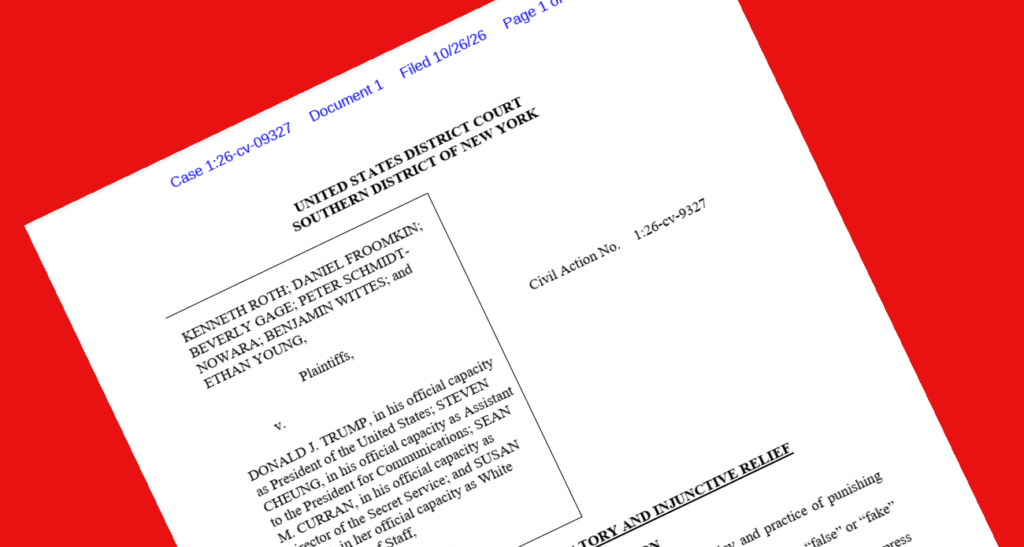

I sued Donald Trump on Monday.
I am one of six plaintiffs in this lawsuit, which argues that Trump’s new policy of banning reporters he doesn’t like from the White House press pool violates the First Amendment.
The unique twist here is that we are suing on the grounds that by threatening and punishing journalists, Trump is also depriving us – the consumers of news – of our rights under the First Amendment.
That’s because freedom of the press doesn’t just guarantee the rights of the press – it also guarantees the public’s right to independent and uncensored information about what our government is doing.
The founders enshrined freedom of the press in the First Amendment precisely so that the public would know what its government was doing – and could vote it out should it, say, become corrupt and despotic.
Timely, huh?
I wrote all about it on Tuesday on MS NOW’s website: “The president admits he’s censoring the free press. That’s why I’m suing him.”
Please go read that piece and come back.
Welcome Back
As I wrote in the piece you just read, we need the White House press pool to ask Trump difficult questions about facts he’d rather not acknowledge, confront him on his lies, and make him listen to the concerns of the American people who themselves have no chance of penetrating his bubble of sycophancy.
Press Watch readers know that I have spent years criticizing White House reporters for not doing enough of that. But Trump’s new policy of threats and punishments would make it nearly impossible. It’s already having a chilling effect on reporting about him.
Three recently banned news organizations – MS NOW, CNN and Politico – sued, citing their First Amendment protections, and a federal judge technically restored their access. But Trump is largely undeterred, and has warned that more bans are coming.
What we really need is for the courts to deliver a ruling that both stops Trump and makes sure nothing like this ever happens again.
What I call my lawsuit is really the work of the Knight First Amendment Institute at Columbia University and the Media Freedom & Information Access Clinic at Yale Law School.
My fellow plaintiffs include human rights warrior Kenneth Roth, Yale history professor Beverly Gage, and Benjamin Wittes, the editor-in-chief of Lawfare.
Roth is named first, so sadly Froomkin v. Trump will not be taught in the law books of the future. But Roth v. Trump may well be.
For the MS NOW piece, I got right to the point. But I originally wrote a version that started off with an example of what we might lose if Trump’s new policy fully takes hold.
So here is the story of Monica Alba, under a new headline:
Monica Alba is the reason I’m suing Trump
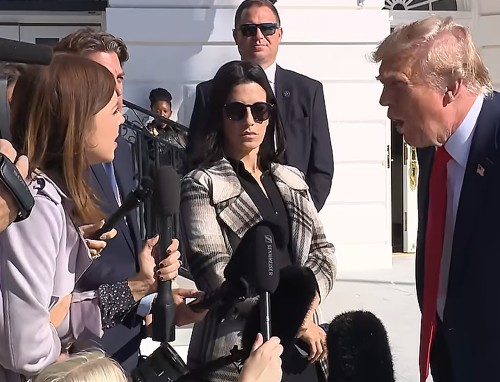 NBC White House correspondent Monica Alba was in the right place at the right time on Friday morning: lined up outside the doors to the Palm Room, waiting for Donald Trump to come out and talk to members of the press corps before taking off for a campaign trip to Florida.
Trump had been monologuing for two days already about how fortunate Republican Ohio gubernatorial candidate Vivek Ramaswamy was to be able to make an attack ad starring his Democratic opponent Amy Acton’s mother – a mother who 48 years ago abandoned her family to run away with the man charged with raping her 12-year-old daughter.
The ad was greeted with nearly universal, even bipartisan revulsion. Ohio Gov. Mike DeWine, a Republican, called it “just wrong” and said “when you know the backstory… it just makes it more wrong.”
But Trump repeatedly said that the mother seemed like a credible source to him, and he reveled in quoting her – endorsing and amplifying Ramaswamy’s depravity.
So Alba’s job that morning was to ask the president, on behalf of the American people, how he could possibly overlook the horrific nature of the family history that Ramaswamy was exploiting.
And that’s what she did, asking Trump: “Now that you know the back story about Amy Acton and her stepfather and why she hasn’t talked to her mom for so long – her stepfather was indicted for rape – now that you know all that, sir, do you change your mind about the ad?”
Trump replied: “No. It’s a mother speaking badly against Amy Acton. And to me, it’s very easy.” After a few more questions, Trump had had enough. “The press is embarrassing themselves,” he said. Another reporter then changed the subject to Ukraine.
But a few minutes later, Alba was back at it, asking Trump the essential question: “Do the sexual abuse allegations mean nothing to you, sir?”
“Wait. Wait, wait, wait,” Trump sputtered. “Slow down. Who are you with? Who are you with?”
When Alba identified her employer, Trump called NBC “one of the worst networks you have.” When she asked her question again, he called her “a fresh person” and “a horrible little reporter.”
Trump continued to defend the ad. “I watched – smart woman,” he said. “I should be so lucky to have an ad like that. Why wouldn’t you listen to a mother that says that? Why? Why, Ms. NBC, why wouldn’t you listen?”
Alba tried to explain, over his continued shouting. “She’s saying that her stepfather was charged with raping his stepdaughter in 1978, sir,” she said.
“This one just keeps talking. You just keep talking,” Trump said.
“I’m answering you, sir,” Alba replied.
Trump continued to defend the ad and repeat the mother’s allegations. “This has nothing to do with a stepfather or anything else,” he said. “This has to do with the fact that a – a woman got out – the mother of a person running for governor of one of the greatest states, where I set records, and said that she’s a liar.”
It was, in the end, a revelatory exchange, and appropriately went viral on social media. Trump’s angry and offensive response when confronted with what would have been easy questions for a normal person indicated more clearly than ever that the man whose own history is replete with credible accusations of sexual assault did not in fact care about Acton’s victimization one bit. There is simply no basic human empathy there.
The exchange also demonstrated the blatant misogyny that has led Trump to personally attack so many women reporters who dared question him.
And there is great value in seeing how the president reacts to reporters’ inquiries. Even if he doesn’t answer the question, his choice to get angry, lie, attack, change the subject, or get flustered speaks volumes.
So on Friday morning, the American people got some of their questions answered. And Alba – who, as a member of the press pool, was one of the few people Trump would face that day with the ability to talk back to him – gave voice to the public’s horror over both the ad and his soulless defense of it.