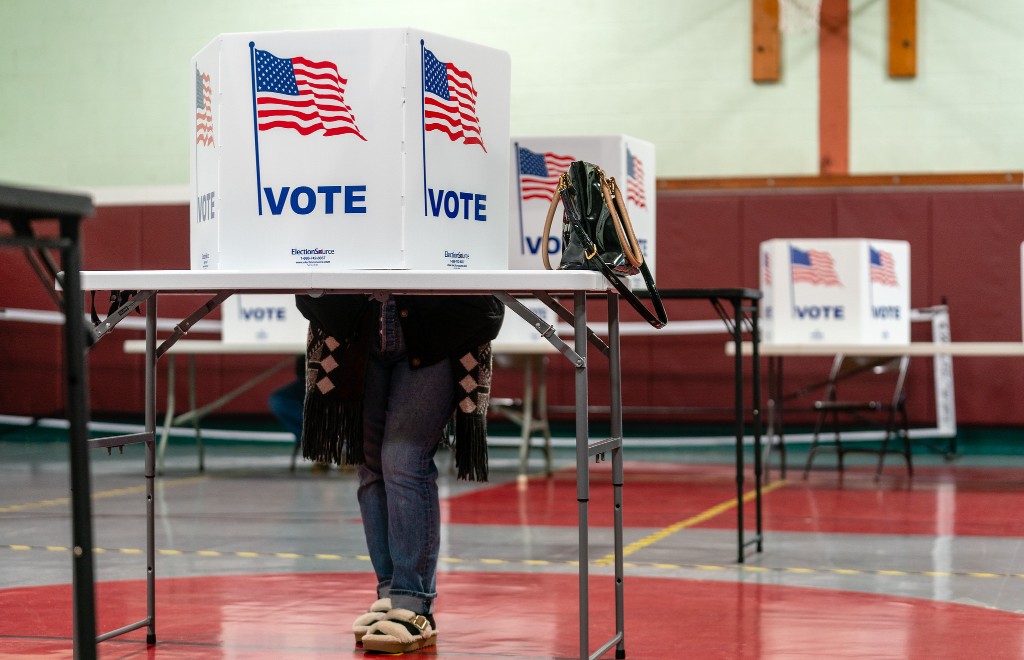

The 2026 U.S. midterm elections will be watched around the world and recorded in the history books for one reason and one reason only: As a measure of how much the American people want to start rolling back Donald Trump’s authoritarian state.
That is what this Election Day is all about. And yet, shockingly, tragically, this element is almost entirely missing from the news media coverage, which has instead focused on the horserace, trivial scandals, and the cost of living. (My Bluesky followers agree.)
In these final days and hours, every news organization in America ought to be topping its home page and front page with articles about what’s at stake in these elections, to make sure its audience fully recognize the urgency and significance of their vote.
More than any congressional elections in history, this year’s have been effectively nationalized. They are a referendum on Trump and on whether it’s time for a massive course correction – or more of the same.
Looking back, there are so many ways news organizations could have told that story. To me, nothing illustrates Trump’s cruelty and lawbreaking more than the sight of masked, heavily armed men terrorizing Black and brown communities. Prominent articles should have said: You can vote for or against that.
Instead – and I have looked hard – I have found only one major news organization that made the connection between ICE’s cruel, inhumane tactics and an election that would put Democrats in a position to block them – or at least try.
(That one article: “How Trump’s immigration crackdown sparked a backlash that could boomerang in the midterms,” by Tim Sullivan and Nicholas Riccardi of the Associated Press, quotes Maryland Sen. Chris Van Hollen saying “The American people supported strong border security. What they got instead was shredding the Constitution, mass deportations and killing American citizens on the streets of Minneapolis.” See, it can be done.)
News organizations could also have focused on how Congress has willingly given up its constitutional role, or on the weaponization of the Justice Department, or on the destruction of swaths of government, or on the war on science, or on the extortion of universities, or on the breathtaking corruption. These are all authoritarian acts – right out of the Authoritarian Playbook. The voters on Election Day get a yea or nay.
They could also have written about plutocracy, war, tariffs, white grievance, chaos, and Trump’s fitness for duty as things to keep in mind while choosing who to vote for.
They could have reviewed the last two years in which the country’s reputation as the world’s greatest democracy has been lost. They could have cast the elections as part of a global movement in which right-wing movements ebb and flow.
They could have written about Election Day as an inflection point in the war in Iran, or the trade war against everyone.
Peltola’s Deception and Stevens’s Defection
As you surely saw, over the last few days the stories getting the most coverage from our major news organizations have not been thoughtful curtain-closers. They involved scandal and/or conflict.
First, the New York Times ran a 3,000-word article proving that Alaska Democratic Senate candidate Mary Peltola’s campaign had been lying when it claimed no involvement in the recruiting of Dan J. Sullivan into the race to pull votes away from Republican Dan S. Sullivan.
I think the Times was right to run that piece – although they could have made it clearer that “ballot stacking” is neither illegal nor unusual in Alaska. Peltola’s campaign lied about it, and deserved to be held accountable for that.
But the Times didn’t need to publish 13 more items about the incident in the next three days. That was overkill – particularly when compared to the dearth of articles addressing the overall stakes on Election Day.
It reminded me a lot of the onslaught of prominent articles the Times published about Hillary Clinton’s email servers just before the 2016 election – except this time, they should have known better.
Back in 2016, the Times overdid and overplayed a Clinton scandal that paled in comparison to dozens in Trump’s history. But they had an excuse: They thought (they knew!) she would win.
In retrospect, of course, it was a huge error to leave readers with the impression that Clinton was maybe a little corrupt without actively reminding them of the vast extent of Trump’s corruption – and also his manifest lack of fitness for the job.
When Trump won, the obvious lesson for the Times was to keep a sense of proportion going forward. (A team of Harvard and MIT researchers found that coverage of Clinton’s email scandal accounted for more sentences than all of Trump’s scandals combined.)
That lesson should have stuck. But it did not.
The other big story of course was the defection of Haley Stevens, who lost the Democratic primary for Michigan’s Senate seat to Abdul El-Sayed. Soon after she announced her endorsement of Republican Mike Rogers – whom she had earlier and for cause described as a “rubber stamp” for “Trump’s dangerous agenda – it became clear that her move was born of pique and spite.
And yet the Times treated this as a huge story about a “meltdown” that reflected badly on both sides. It did not. The Associated Press article was even more inaccurate, suggesting that “Democratic tensions boiled over.”
Conflict and both-sidesing. That’s what political reporters live for.
Why Why Why?
How can our top news organizations have whiffed on the biggest story in the world?
Are the stakes on Election Day something that the nation’s political journalists think is so obvious they don’t have to say it?
They have to say it.
Or do they not see it that way?
They can’t be that blind.
Or do they feel that stating this clearly would be agreeing with partisans – and therefore would undermine their independence?
That’s certainly what’s happening at the New York Times, where the big boss, AG Sulzberger, has made clear that it is not independent journalism’s role to sound the alarm about democracy. “The alarm seems so loud and so constant that much of the public has by now put in earplugs,” he said in March 2024. (Yes, eight months before Trump was reelected.)
(This reminds me of what Patrick Healy, a major figure in “but her emails” and now senior Times editor in charge of enforcing bad rules, told my fellow media critic Mark Jacob in a revealing dialogue last month. Healy explained that the Times was worried that overuse of the word “lie” would “lose the potency of the word itself” – to which Jacob replied: “Well, so you’re saying you want to retain the potency of the word ‘lie’ by not using it?” Bravo!)
And yes, it’s true that the Democrats aren’t really advancing the threats-to-democracy narrative. They’ve stressed affordability above all – the focus groups must love that – and they tar their opponents with their association to Trump but don’t say how they plan to block him. That’s no excuse, though.
There is one legitimate reason to doubt that a blue wave (if it happens) is proof that the country is now anti-autocratic: the salience of high gas prices and other necessities.
It is possible that a rejection of Trump would be fueled more by gas and less by high principles. But that would be reason to question the election as a sign of the resurgence of American democracy – which is how the entire world will see it – not to ignore it.
The Curtain-Closers
I thought the news analysis by Peter Baker and Dylan Freedman in Sunday’s Times headlined “Threats, Gaffes and Men’s Posteriors: Trump’s Talk Gets Wilder,” made some important points about Trump’s mental fitness – a very appropriate topic this week.
Their review concluded that “Trump’s public communication is more vulgar, more uninhibited and less coherent than it was a decade ago.” They wrote about “revived questions about his age and stability”; that his increase in the use of absolutist language is something that “experts say often accompanies advancing age or cognitive decline”; and that his increased cursing is “a change consistent with age-related disinhibition.”
Bravo, right?
Yes and no. The article is still way too gentle. He’s completely unfit to be president.
And while the article contrasted starkly with the sanewashing that happens daily in the Times and elsewhere, it won’t change anything about that coverage. I know that because in April, Baker penned a remarkable piece in which he described concerns that Trump is “clearly insane.” He actually quoted a wide range of people calling Trump “an extremely sick person,” “unhinged,” “out of control,” “batshit crazy,” and “a genocidal lunatic.” But like Sunday’s piece, it was a one-and-done, never to be referenced again.
Over at the Washington Post, Cat Zakrzewski and Katherine Doyle wrote about Trump’s last rallies marking the end of a political era. A useful wrap-up would have reported that the rallies featured hour after hour of incoherent ranting, ugly stand-up routines, threats, white grievance, racist screeds, and endless lies. But how does the Post describe them as they wrap up? As “a unique mix of politics and entertainment, combining the theatrics of a rock concert, the fervor of a Christian revival and the fierce loyalties of a sporting event.”
I was initially encouraged by the New York Times headline: “The Parties Make Their Closing Arguments: ‘This Isn’t Just Red Versus Blue’.” And Lisa Lerer started off defining the contest as being about “economic anxiety, a backlash to the Iran war and disapproval of President Trump’s second-term agenda,” which at least accurately reflected how it was covered.
But then came an extraordinary irony. The man whose quote was in the headline was the Republican Senate candidate from Texas, Ken Paxton, one of the most morally-compromised of the insult-spewing Trump toadies running for office. And the rest of the quote was “It’s the America our founders gave us versus something they would never recognize.”
Lerer left that quote naked, with no comment, when she knows – and we know – that it’s Trump’s America that would be unrecognizable to the founders, on account of his abuses of power, his corruption, and his contempt for the law.
So what Paxton said was right, just in a completely opposite way.
And on Election Day, we’ll know if the great struggle to return the country to the balance intended by the founders – to return America to democracy – will start now, or not.
–– – – – – – – – – – – –
I almost headlined this article “If the Blue Wave isn’t a tsunami, blame the New York Times,” because a lot of the same themes came up in 2024 when I blamed the Times in anticipation of Trump’s victory, and the entire news media after it happened.